Engineering Mechanics: Statics and Dynamics, 14th Edition
Authors: Russell C. Hibbeler
ISBN-13: 978-0133915426
See our solution for Question 64P from Chapter 5 from Hibbeler's Engineering Mechanics.
Problem 64P
Step-by-Step Solution
We are given the forces ${F_1} = 400\;{\rm{N}}$, ${F_2} = 500\;{\rm{N}}$, and ${F_3} = 600\;{\rm{N}}$.
We are asked to determine the components of reaction at the fixed support $A$.
Step 2
We will draw a free body diagram of the assembly.
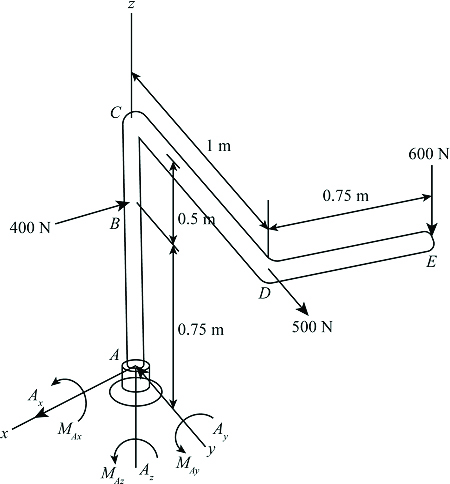
Here, ${A_x}$ is the reaction force at point $A$, ${A_y}$ is the reaction force at point $A$, ${A_z}$ is the reaction force at point $A$, ${M_{Ax}}$ is the moment about $x$-axis, ${M_{Ay}}$ is the moment about $y$-axis, and ${M_{Az}}$ is the moment about $z$-axis.
The length $AB$ is $AB = 0.75\;{\rm{m}}$.
The length $BC$ is $BC = 0.5\;{\rm{m}}$.
The length $CD$ is $CD = 1\;{\rm{m}}$.
The length $DE$ is $DE = 0.75\;{\rm{m}}$.
Step 3
We will resolve the forces along the $x$-axis to find the reaction force at point $A$.
\[\begin{array}{c} \sum {{F_x}} = 0\\ {A_x} - {F_1} = 0 \end{array}\]Substitute the given value in the above equation.
\[\begin{array}{c} {A_x} - 400\;{\rm{N}} = 0\\ {A_x} = 400\;{\rm{N}} \end{array}\]Step 4
We will resolve the forces along the $y$-axis to find the reaction force at point $A$.
\[\begin{array}{c} \sum {{F_y}} = 0\\ {A_y} - {F_2} = 0 \end{array}\]Substitute the given value in the above equation.
\[\begin{array}{c} {A_y} - 500\;{\rm{N}} = 0\\ {A_y} = 500\;{\rm{N}} \end{array}\]Step 5
We will resolve the forces along the $z$-axis to find the reaction force at point $A$.
\[\begin{array}{c} \sum {{F_z}} = 0\\ {A_z} - {F_3} = 0 \end{array}\]Substitute the given value in the above equation.
\[\begin{array}{c} {A_z} - 600\;{\rm{N}} = 0\\ {A_z} = 600\;{\rm{N}} \end{array}\]Step 6
We will take the moment about the $x$-axis to find the moment at point $A$.
\[\begin{array}{c} \sum {{M_{Ax}}} = 0\\ {M_{Ax}} - {F_2} \times \left( {AB + BC} \right) - {F_3} \times CD = 0\\ {M_{Ax}} = {F_2} \times \left( {AB + BC} \right) + {F_3} \times CD \end{array}\]Substitute the given value in the above equation.
\[\begin{array}{c} {M_{Ax}} = \left( {{\rm{500}}\;{\rm{N}}} \right) \times \left( {{\rm{0}}{\rm{.75}}\;{\rm{m}} + {\rm{0}}{\rm{.5}}\;{\rm{m}}} \right) + \left( {{\rm{600}}\;{\rm{N}}} \right) \times \left( {1\;{\rm{m}}} \right)\\ = 1225\;{\rm{N}} \cdot {\rm{m}} \end{array}\]Step 7
We will take the moment about the $y$-axis to find the moment at point $A$.
\[\begin{array}{c} \sum {{M_{Ay}}} = 0\\ {M_{Ay}} - {F_1} \times AB - {F_3} \times DE = 0\\ {M_{Ay}} = {F_1} \times AB + {F_3} \times DE \end{array}\]Substitute the given value in the above equation.
\[\begin{array}{c} {M_{Ay}} = \left( {{\rm{400}}\;{\rm{N}}} \right) \times \left( {{\rm{0}}{\rm{.75}}\;{\rm{m}}} \right) + \left( {{\rm{600}}\;{\rm{N}}} \right) \times \left( {0.75\;{\rm{m}}} \right)\\ = 750\;{\rm{N}} \cdot {\rm{m}} \end{array}\]Step 8
We will take the moment about the $z$-axis to find the moment at point $A$.
\[\begin{array}{c} \sum {{M_{Az}}} = 0\\ {M_{Az}} = 0\;{\rm{N}} \cdot {\rm{m}} \end{array}\]