Engineering Mechanics: Statics and Dynamics, 14th Edition
Authors: Russell C. Hibbeler
ISBN-13: 978-0133915426
See our solution for Question 11P from Chapter 6 from Hibbeler's Engineering Mechanics.
Problem 11P
Step-by-Step Solution
We are given the following data:
The magnitude of the first force is ${F_1} = 10\;{\rm{kN}}$.
The magnitude of the second force is ${F_2} = 20\;{\rm{kN}}$.
The magnitude of the third force is ${F_3} = 10\;{\rm{kN}}$.
We are asked to determine the force in each member of the Pratt truss, and also state if the members are in tension or compression.
Step 2
We will draw the free-body diagram of the truss.

Here, ${A_y}$ and ${G_y}$ are the vertical component of supports at point $A$ and $G$ respectively and ${A_x}$ is the horizontal component of support at point $A$.
Step 3
The given truss is symmetrically loaded and is symmetric about center. So, the forces in the corresponding members are the same.
Force in member $AL$ and $HG$ are equal with each other.
Force in member $AB$ and $FG$ are equal with each other.
Force in member $BL$ and $HF$ are equal with each other.
Force in member $BC$ and $EF$ are equal with each other.
Force in member $LC$ and $HE$ are equal with each other.
Force in member $CK$ and $EI$ are equal with each other.
Force in member $CD$ and $ED$ are equal with each other.
Force in member $LK$ and $HI$ are equal with each other.
Force in member $KJ$ and $IJ$ are equal with each other.
Force in member $KD$ and $ID$are equal with each other.
Step 4
The formula to calculate the angle $\theta $ is given by,
\[\theta = {\tan ^{ - 1}}\left( {\frac{{{y_1}}}{{AB}}} \right)\]Substitute all the known values in the above formula.
\[\begin{array}{c} \theta = {\tan ^{ - 1}}\left( {\frac{{2\;{\rm{m}}}}{{2\;{\rm{m}}}}} \right)\\ \theta = {\tan ^{ - 1}}\left( 1 \right)\\ \theta = 45^\circ \end{array}\]Step 5
The formula to calculate the angle $\alpha $ is given by,
\[\alpha = {\tan ^{ - 1}}\left( {\frac{{{y_1} + {y_2}}}{{CD}}} \right)\]Substitute all the known values in the above formula.
\[\begin{array}{c} \alpha = {\tan ^{ - 1}}\left( {\frac{{2\;{\rm{m}}\;{\rm{ + }}\,{\rm{2}}\;{\rm{m}}}}{{2\;{\rm{m}}}}} \right)\\ \alpha = {\tan ^{ - 1}}\left( 2 \right)\\ \alpha = 63.43^\circ \end{array}\]Step 6
We will apply the equations of equilibrium along the $x$ axis.
\[\begin{array}{c} \sum {{F_x}} = 0\\ {A_x} = 0 \end{array}\]Step 7
We will apply the equations of equilibrium along the $y$ axis.
\[\begin{array}{c} \sum {{F_y}} = 0\\ \left[ {{A_y} - {G_y} - {F_1} - {F_2} - {F_3}} \right] = 0 \end{array}\]Substitute all the known values in the above formula.
\[\begin{array}{c} \left[ {{A_y} - {G_y} - \left( {10\,{\rm{kN}}} \right) - \left( {20\,{\rm{kN}}} \right) - \left( {10\,{\rm{kN}}} \right)} \right] = 0\\ 2{A_y} = 40\;{\rm{kN}}\\ {A_y} = 20\;{\rm{kN}} \end{array}\]Step 8
We will draw the free-body diagram of the joint $A$.

We will apply the equations of the equilibrium along $y$ axis.
\[\begin{array}{c} \sum {{F_y}} = 0\\ \left[ {{A_y} + \left( {{F_{AL}}\sin \theta } \right)} \right] = 0 \end{array}\]Substitute all the known values in the above equation.
\[\begin{array}{c} \left[ {\left( {2 0\;{\rm{kN}}} \right) + \left( {{F_{AL}}\sin 45^\circ } \right)} \right] = 0\\ {F_{AL}} = - \left[ {\frac{{\left( {20\;{\rm{kN}}} \right)}}{{\sin 45^\circ }}} \right]\\ {F_{AL}} = - 28.28\;{\rm{kN}} \end{array}\]Therefore, the magnitude of the force in the member $AL$ and $HG$ is ${F_{AL}} = {F_{HG}} = 28.28\;{\rm{kN}}$ and the nature of the force is compressive.
Step 9
We will apply the equations of the equilibrium along $x$ axis.
\[\begin{array}{c} \sum {{F_x}} = 0\\ \left[ {\left( {{F_{AL}}\cos \theta } \right) + {F_{AB}}} \right] = 0 \end{array}\]Substitute all the known values in the above equation.
\[\begin{array}{c} \left[ {\left\{ {\left( { - 28.28\;{\rm{kN}}} \right)\cos 45^\circ } \right\} + {F_{AB}}} \right] = 0\\ {F_{AB}} = 20\;{\rm{kN}} \end{array}\]Therefore, the magnitude of the force in the member $AB$ and $FG$ is ${F_{AB}} = {F_{FG}} = 20\;{\rm{kN}}$ and the nature of the force is tension.
Step 10
We will draw the free-body diagram of the joint $B$.
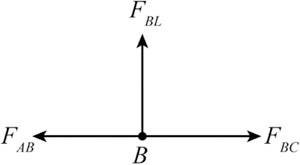
We will apply the equations of the equilibrium along $y$ axis.
\[\begin{array}{c} \sum {{F_y}} = 0\\ {F_{BL}} = 0 \end{array}\]Therefore, the magnitude of the force in the member $BL$ and $FH$ is ${F_{BL}} = {F_{FH}} = 0\;{\rm{kN}}$.
Step 11
We will apply the equations of the equilibrium along $x$ axis.
\[\begin{array}{c} \sum {{F_x}} = 0\\ \left[ { - {F_{AB}} + {F_{BC}}} \right] = 0 \end{array}\]Substitute all the known values in the above equation.
\[\begin{array}{c} \left[ {\left( { - 20\;{\rm{kN}}} \right) + {F_{BC}}} \right] = 0\\ {F_{BC}} = 20\;{\rm{kN}} \end{array}\]Therefore, the magnitude of the force in the member $BC$ and $EF$ is ${F_{BC}} = {F_{EF}} = 20\;{\rm{kN}}$ and the nature of the force is tension.
Step 12
We will draw the free-body diagram of the joint $L$.
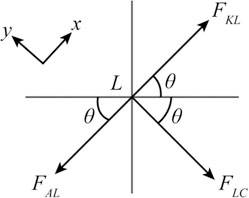
We will apply the equations of the equilibrium along $x$ axis.
\[\begin{array}{c} \sum {{F_x}} = 0\\ \left[ {{F_{KL}} - {F_{AL}}} \right] = 0 \end{array}\]Substitute all the known values in the above equation.
\[\begin{array}{c} \left[ {{F_{KL}} - \left( { - 28.28\;{\rm{kN}}} \right)} \right] = 0\\ {F_{KL}} = - 28.28\;{\rm{kN}} \end{array}\]Therefore, the magnitude of the force in the member $KL$ and $HI$ is ${F_{KL}} = {F_{HI}} = 28.28\;{\rm{kN}}$ and the nature of the force is compressive.
Step 13
We will apply the equations of the equilibrium along $y$ axis.
\[\begin{array}{c} \sum {{F_y}} = 0\\ \left[ { - {F_{LC}}} \right] = 0 \end{array}\]Therefore, the magnitude of the force in the member $LC$ and $HE$ is ${F_{LC}} = {F_{HE}} = 0\;{\rm{kN}}$.
Step 14
We will draw the free-body diagram of the joint $C$.
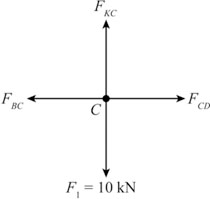
We will apply the equations of the equilibrium along $y$ axis.
\[\begin{array}{c} \sum {{F_y}} = 0\\ \left[ {{F_{KC}} - {F_1}} \right] = 0 \end{array}\]Substitute all the known values in the above equation.
\[\begin{array}{c} \left[ {{F_{KC}} - \left( {10\;{\rm{kN}}} \right)} \right] = 0\\ {F_{KC}} = 10\;{\rm{kN}} \end{array}\]Therefore, the magnitude of the force in the member $KC$ and $IE$ is ${F_{KC}} = {F_{IE}} = 10\;{\rm{kN}}$ and the nature of the force is tension.
Step 15
We will apply the equations of the equilibrium along $x$ axis.
\[\begin{array}{c} \sum {{F_x}} = 0\\ \left[ {{F_{CD}} - {F_{BC}}} \right] = 0 \end{array}\]Substitute all the known values in the above equation.
\[\begin{array}{c} \left[ {{F_{CD}} - \left( {20\;{\rm{kN}}} \right)} \right] = 0\\ {F_{CD}} = 20\;{\rm{kN}} \end{array}\]Therefore, the magnitude of the force in the member $CD$ and $DE$ is ${F_{CD}} = {F_{DE}} = 20\;{\rm{kN}}$ and the nature of the force is tension.
Step 16
We will draw the free-body diagram of the joint $K$.
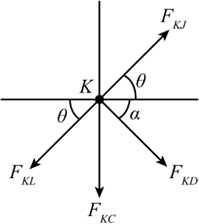
We will apply the equations of the equilibrium along $x$ axis.
\[\begin{array}{c} \sum {{F_x}} = 0\\ \left[ {\left( {{F_{KJ}}\cos \theta } \right) + \left( {{F_{KD}}\cos \alpha } \right) - \left( {{F_{KL}}\cos \theta } \right)} \right] = 0 \end{array}\]Substitute all the known values in the above equation.
\[\begin{array}{c} \left[ \begin{array}{l} \left( {{F_{KJ}}\cos 45^\circ } \right) + \left( {{F_{KD}}\cos 63.43^\circ } \right)\\ - \left( { - 28.28\;{\rm{kN}}} \right)\left( {\cos 45^\circ } \right) \end{array} \right] = 0\\ \left[ {\left( {0.707{F_{KJ}}} \right) + \left( {0.447{F_{KD}}} \right)} \right] = \left( { - 20} \right)\;{\rm{kN}}\\ {F_{KJ}} = \left( {\frac{{ - 20\; - 0.447{F_{KD}}}}{{0.707}}} \right)\;{\rm{kN}} \end{array}\]Step 17
We will apply the equations of the equilibrium along $y$ axis.
\[\begin{array}{c} \sum {{F_y}} = 0\\ \left[ \begin{array}{l} \left( {{F_{KJ}}\sin \theta } \right) - \left( {{F_{KD}}\sin \alpha } \right)\\ - \left( {{F_{KL}}\sin \theta } \right) - {F_{KC}} \end{array} \right] = 0 \end{array}\]Substitute all the known values in the above equation.
\[\begin{array}{c} \left[ \begin{array}{l} \left\{ {\left( {\frac{{ - 20\; - 0.447{F_{KD}}}}{{0.707}}} \right)\sin 45^\circ } \right\}\;{\rm{kN}} - \left( {{F_{KD}}\sin 63.43^\circ } \right)\\ - \left( { - 28.28\;{\rm{kN}}} \right)\left( {\sin 45^\circ } \right) - \left( {10\;{\rm{kN}}} \right) \end{array} \right] = 0\\ \left( { - 1.3414} \right) = \left( {10} \right)\;{\rm{kN}}\\ {F_{KD}} = - 7.46\;{\rm{kN}} \end{array}\]Therefore, the magnitude of the force in the member $KD$ and $ID$ is ${F_{KD}} = {F_{ID}} = 7.46\;{\rm{kN}}$ and the nature of the force is compressive.
Step 18
Substitute the value ${F_{KD}} = - 7.46\;{\rm{kN}}$ in the equation ${F_{KJ}} = \left( {\frac{{ - 20\; - 0.447{F_{KD}}}}{{0.707}}} \right)\;{\rm{kN}}$ to obtain ${F_{KJ}}$.
\[\begin{array}{c} {F_{KJ}} = \left( {\frac{{ - 20\; - 0.447\left( { - 7.46} \right)}}{{0.707}}} \right)\;{\rm{kN}}\\ {F_{KJ}} = - {\rm{23}}{\rm{.57}}\;{\rm{kN}} \end{array}\]Therefore, the magnitude of the force in the member $KJ$ and $IJ$ is ${F_{KJ}} = {F_{IJ}} = 23.57\;{\rm{kN}}$ and the nature of the force is compressive.
Step 19
We will draw the free-body diagram of the joint $J$.
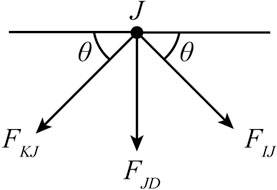
We will apply the equations of the equilibrium along $y$ axis.
\[\begin{array}{c} \sum {{F_y}} = 0\\ \left[ { - {F_{JD}} - \left( {{F_{KJ}}\sin \theta } \right) - \left( {{F_{IJ}}\sin \theta } \right)} \right] = 0 \end{array}\]Substitute all the known values in the above equation.
\[\begin{array}{c} \left[ \begin{array}{l} - {F_{JD}} - \left( { - 23.57\sin 45^\circ } \right)\\ - \left( { - 23.57\sin 45^\circ } \right) \end{array} \right] = 0\\ {F_{JD}} = 33.33\;{\rm{kN}} \end{array}\]Therefore, the magnitude of the force in the member $JD$ is ${F_{JD}} = 33.33\;{\rm{kN}}$ and the nature of the force is tension.