Engineering Mechanics: Statics and Dynamics, 14th Edition
Authors: Russell C. Hibbeler
ISBN-13: 978-0133915426
See our solution for Question 24P from Chapter 6 from Hibbeler's Engineering Mechanics.
Problem 24P
Step-by-Step Solution
We are given that the maximum tensile force for the truss is ${F_t} = 5\;{\rm{kN}}$ and the maximum compressive force for the truss is ${F_c} = 3\;{\rm{kN}}$. The value of constant is $d = 2\;{\rm{m}}$.
We are asked to calculate the maximum value of load for the truss.
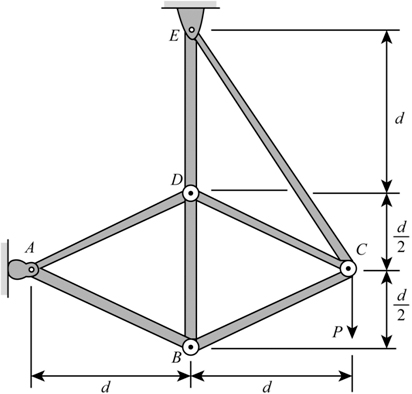
We have the distance between point A and B is ${d_1} = d$.
We have the distance between point B and C is ${d_2} = d$.
We have the vertical distance between point B and C is ${h_1} = \frac{d}{2}$.
We have the vertical distance between point C and D is ${h_2} = \frac{d}{2}$.
We have the vertical distance between point E and D is ${h_3} = d$.
Step 2
The free body diagram of the tress is shown as:

Step 3
To calculate the inner angle of the truss we use the formula:
\[\tan \alpha = \frac{{{h_3}}}{{{d_2}}}\]Step 4
Substitute the known values in the formula:
\[\begin{array}{c} \tan \alpha = \frac{{\frac{d}{2}}}{d}\\ \alpha = {\tan ^{ - 1}}\left( {\frac{1}{2}} \right)\\ = 26.56^\circ \end{array}\]Step 5
To calculate the upper angle of the truss we use the formula:
\[\tan \theta = \frac{{{d_2}}}{{{h_2} + {h_3}}}\]Step 6
Substitute the known values in the formula:
\[\begin{array}{c} \tan \theta = \frac{d}{{\frac{d}{2} + d}}\\ \theta = {\tan ^{ - 1}}\left( {\frac{2}{3}} \right)\\ = 33.69^\circ \end{array}\]Step 7
Applying the moment of forces equation about point E:
\[{A_x}\left( {{h_2} + {h_3}} \right) - P{d_2} = 0\]Step 8
Substitute the known values in the equation:
\[\begin{array}{c} {A_x}\left( {\frac{d}{2} + d} \right) - Pd = 0\\ {A_x}\left( {\frac{3}{2}d} \right) = Pd\\ {A_x} = 0.6667P \end{array}\] Step 9Applying the force of equilibrium along x-axis at point E:
\[\begin{array}{c} \sum {F_x} = 0\\ {A_x} - {E_x} = 0\\ {E_x} = {A_x} \end{array}\]Step 10
Substitute the known value in the equation:
\[{E_x} = 0.6667P\]Step 11
Applying the force of equilibrium along y-axis at point E:
\[\begin{array}{c} \sum {F_y} = 0\\ {E_y} - P = 0\\ {E_y} = P \end{array}\]Step 12
Applying the force of equilibrium along horizontal direction at point E:
\[\begin{array}{c} \sum {F_x} = 0\\ {F_{EC}}\sin \theta - {E_x} = 0 \end{array}\]Step 13
Substitute the known values in the equation:
\[\begin{array}{c} {F_{EC}}\sin 33.69^\circ - 0.6667P = 0\\ {F_{EC}}\left( {0.555} \right) = 0.6667P\\ {F_{EC}} = 1.20P \end{array}\]Step 14
Applying the force of equilibrium along vertical direction at point E:
\[\begin{array}{c} \sum {F_y} = 0\\ {E_y} - {F_{ED}} - {F_{EC}}\cos \theta = 0 \end{array}\]Step 15
Substitute the known values in the equation:
\[\begin{array}{c} P - {F_{ED}} - \left( {1.20P} \right)\cos 33.69^\circ = 0\\ {F_{ED}} = P - \left( {1.20P} \right)\left( {0.832} \right)\\ = P - P\\ = 0 \end{array}\]Step 16
Applying the force of equilibrium along vertical direction at point A:
\[\begin{array}{c} \sum {F_y} = 0\\ {F_{AD}}\sin \alpha - {F_{AB}}\sin \alpha = 0\\ {F_{AD}}\sin \alpha = {F_{AB}}\sin \alpha \\ {F_{AD}} = {F_{AB}} \end{array}\]...... (1)Step 17
Applying the force of equilibrium along horizontal direction at point A:
\[\begin{array}{c} \sum {F_x} = 0\\ {A_x} + {F_{AD}}\cos \alpha + {F_{AB}}\cos \alpha = 0 \end{array}\]Step 18
Substitute the known values in the equation:
\[\begin{array}{c} 0.6667P + {F_{AD}}\cos 26.57^\circ + {F_{AD}}\cos 26.57^\circ = 0\\ 2{F_{AD}}\left( {0.894} \right) = - 0.6667P\\ {F_{AD}} = - 0.3727P \end{array}\]Step 19
Substitute the known value in equation (1):
\[{F_{AB}} = 0.3727P\]Step 20
Applying the force of equilibrium along horizontal direction at point D:
\[\begin{array}{c} \sum {F_x} = 0\\ {F_{DC}}\cos \alpha - {F_{AD}}\cos \alpha = 0\\ {F_{DC}}\cos \alpha = {F_{AD}}\cos \alpha \\ {F_{DC}} = {F_{AD}} \end{array}\]Step 21
Substitute the known values in the equation:
\[{F_{DC}} = - 0.3727P\]Step 22
Applying the force of equilibrium along vertical direction at point D:
\[\begin{array}{c} \sum {F_y} = 0\\ {F_{ED}} - {F_{DB}} - {F_{AD}}\sin \alpha - {F_{DC}}\sin \alpha = 0 \end{array}\]Step 23
Substitute the known values in the equation:
\[\begin{array}{c} \left\{ \begin{array}{l} 0 - {F_{DB}} - \left( { - 0.3727P} \right)\sin 26.57^\circ \\ - \left( { - 0.3727P} \right)\sin 26.57^\circ \end{array} \right\} = 0\\ {F_{DB}} = 2\left( {0.3727P} \right)\left( {0.447} \right)\\ = 0.333P \end{array}\]Step 24
Applying the force of equilibrium along horizontal direction at point B:
\[\begin{array}{c} \sum {F_x} = 0\\ {F_{BC}}\cos \alpha - {F_{AB}}\cos \alpha = 0\\ {F_{BC}}\cos \alpha = {F_{AB}}\cos \alpha \\ {F_{BC}} = {F_{AB}} \end{array}\]Step 25
Substitute the known values in the equation:
\[{F_{BC}} = - 0.3727P\]Step 26
The maximum tension is in member EC which is given by,
\[{F_{EC}} = 1.20P\]Step 27
Substitute the known value of maximum tension in equation:
\[\begin{array}{c} 5\;{\rm{kN}} = 1.20P\\ P = \frac{{5\;{\rm{kN}}}}{{1.20}}\\ = 4.16\;{\rm{kN}} \end{array}\]Step 28
The maximum compression is in member AB of truss which is given as,
\[{F_{AB}} = 0.3727P\]Step 29
Substitute the known value of maximum compression in equation:
\[\begin{array}{c} 3\;{\rm{kN}} = 0.3727P\\ P = \frac{{3\;{\rm{kN}}}}{{0.3727}}\\ = 8.05\;{\rm{kN}} \end{array}\]For safe design of the truss, consider the minimum allowable force. Therefore, the maximum load that can be applied is $4.16\;{\rm{kN}}$.