Engineering Mechanics: Statics and Dynamics, 14th Edition
Authors: Russell C. Hibbeler
ISBN-13: 978-0133915426
See our solution for Question 61P from Chapter 6 from Hibbeler's Engineering Mechanics.
Problem 61P
Step-by-Step Solution
We are given the weight $W = 100\;{\rm{lb}}$.
We are asked to determine the force $P$.
Step 2
The free-body diagram of the pulley and the weight system can be drawn as:
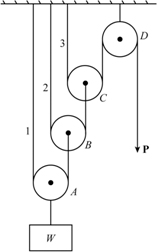
To calculate the tension in the pulley A, we need to draw the free-body diagram of the pulley A as:
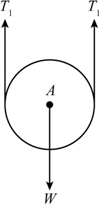
Here, ${T_1}$ is the tension in the string 1 and W is the weight.
On applying the equilibrium condition along the vertical direction, we get:
\[\begin{array}{c} \sum {F_y} = 0\\ {T_1} + {T_1} - W = 0\\ 2{T_1} = \left( {100\;{\rm{lb}}} \right)\\ {T_1} = 50\;{\rm{lb}} \end{array}\]To calculate the tension in the pulley B, we need to draw the free-body diagram of the pulley B as:
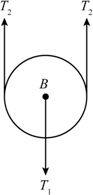
Here, ${T_2}$ is the tension in the string 2.
On applying the equilibrium condition along the vertical direction, we get:
\[\begin{array}{c} \sum {F_y} = 0\\ 2{T_2} - {T_1} = 0\\ 2{T_2} = \left( {50\;{\rm{lb}}} \right)\\ {T_2} = 25\;{\rm{lb}} \end{array}\]Step 3
To calculate the tension in the pulley C, we need to draw the free-body diagram of the pulley C as:
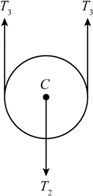
Here, ${T_3}$ is the tension in the string 3.
On applying the equilibrium condition along the vertical direction, we get:
\[\begin{array}{c} \sum {F_y} = 0\\ 2{T_3} - {T_2} = 0\\ 2{T_3} = \left( {25\;{\rm{lb}}} \right)\\ {T_3} = 12.5\;{\rm{lb}} \end{array}\]Since, the applied force will be equal to the tension in the string 3. Therefore,
\[\begin{array}{c} P = {T_3}\\ P = 12.5\;{\rm{lb}} \end{array}\]