Engineering Mechanics: Statics and Dynamics, 14th Edition
Authors: Russell C. Hibbeler
ISBN-13: 978-0133915426
See our solution for Question 76P from Chapter 6 from Hibbeler's Engineering Mechanics.
Problem 76P
Step-by-Step Solution
We are given the following data:
The magnitude of the uniform loading is $W = 400\;{\rm{N/m}}$.
The horizontal distance between the point $D$ and the point $C$ is $DC = 2\;{\rm{m}}$.
The distance between the point $A$ and the point $E$ is $AE = 3\;{\rm{m}}$.
The distance between the point $E$ and the point $D$ is $DE = 1.5\;{\rm{m}}$.
The distance between the point $C$ and the point $F$ is $CF = 3\;{\rm{m}}$.
The distance between the point $B$ and the point $F$ is $BF = 1.5\;{\rm{m}}$.
We are asked to determine the horizontal and vertical components of force which the pins at $A$ and $B$ exert on the frame.
Step 2
The formula to calculate the resultant force of the uniform distributed loading is given by,
\[F = \left( W \right) \times \left( {AE + ED} \right)\]Here, $F$ represent the resultant point force of the uniform distributed load.
Substitute all the known values in the above formula.
\[\begin{array}{c} F = \left( {400\;{\rm{N/m}}} \right)\left( {3\;{\rm{m}}\;{\rm{ + }}\;1.5\;{\rm{m}}} \right)\\ = \left( {400\;{\rm{N/m}}} \right) \times \left( {4.5\;{\rm{m}}} \right)\\ = 1800\;{\rm{N}} \end{array}\]Step 3
The formula to calculate the distance of the resultant point force from the point $A$ is given by,
\[{x_1} = \frac{1}{2} \times \left( {AE + ED} \right)\]Here, ${x_1}$ represent the distance of the resultant point force from the point $A$.
Substitute all the known values in the above formula.
\[\begin{array}{c} {x_1} = \frac{1}{2} \times \left( {3\;{\rm{m}}\;{\rm{ + }}\;1.5\;{\rm{m}}} \right)\\ = \frac{{\left( {4.5\;{\rm{m}}} \right)}}{2}\\ = 2.25\;{\rm{m}} \end{array}\]Step 4
We will draw a free body diagram of the part $AED$ of the frame.
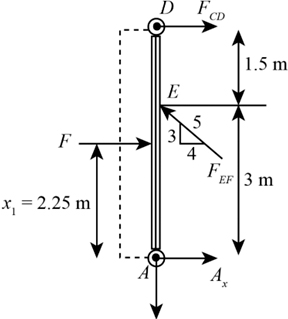
Here, ${F_{{\rm{CD}}}}$ is the force in the member $CD$, ${F_{{\rm{EF}}}}$ is the force in the member $EF$ of the frame, ${A_y}$ is the vertical reaction force, and ${A_{\rm{x}}}$ is the horizontal force.
We will take the sum of the moments about point $A$ equal to zero to determine the equation between the force ${F_{{\rm{EF}}}}$. And ${F_{{\rm{CD}}}}$.
\[\begin{array}{c} \sum {{M_{\rm{A}}}} = 0\\ \left[ \begin{array}{l} \left( {{F_{{\rm{EF}}}}} \right)\left( {\frac{4}{5}} \right)\left( {AE} \right)\\ - \left( {{F_{{\rm{CD}}}}} \right)\left( {AE + ED} \right)\\ - \left( F \right)\left( {{x_1}} \right) \end{array} \right] = 0 \end{array}\]Substitute the known value in the above equation.
\[\begin{array}{c} \left[ \begin{array}{l} \left( {{F_{{\rm{EF}}}}} \right)\left( {\frac{4}{5}} \right)\left( {3\;{\rm{m}}} \right)\\ - \left( {{F_{{\rm{CD}}}}} \right)\left( {3\;{\rm{m}}\;{\rm{ + }}\;1.5\;{\rm{m}}} \right)\\ - \left( {1800\;{\rm{N}}} \right)\left( {2.25\;{\rm{m}}} \right) \end{array} \right] = 0\\ \left[ {\left( {{F_{{\rm{EF}}}}} \right)\left( {2.4\;{\rm{m}}} \right) - \left( {{F_{{\rm{CD}}}}} \right)\left( {4.5\;{\rm{m}}} \right)} \right] = \left( {4050\;{\rm{N}} \cdot {\rm{m}}} \right)\\ {F_{{\rm{EF}}}} = \frac{{\left[ {\left( {4050\;{\rm{N}} \cdot {\rm{m}}} \right) + \left( {{F_{{\rm{CD}}}}} \right)\left( {4.5\;{\rm{m}}} \right)} \right]}}{{\left( {2.4\;{\rm{m}}} \right)}} \end{array}\]Step 5
We will draw the free-body diagram of the member $BC$ of the frame.
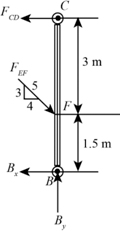
Here, ${B_{\rm{x}}}$ is the horizontal force and ${B_{\rm{y}}}$ is the vertical force at point $B$ of the frame.
We will take the sum of the moments about point $B$ equal to zero to determine the equation between the force ${F_{{\rm{EF}}}}$. And ${F_{{\rm{CD}}}}$.
\[\begin{array}{c} \sum {{M_{\rm{B}}}} = 0\\ \left[ {\left( { - {F_{{\rm{EF}}}}} \right)\left( {\frac{4}{5}} \right)\left( {BF} \right) + \left( {{F_{{\rm{CD}}}}} \right)\left( {BF + CF} \right)} \right] = 0 \end{array}\]Substitute the known value in the above equation.
\[\begin{array}{c} \left[ \begin{array}{l} - \left[ {\frac{{\left[ {\left( {4050\;{\rm{N}} \cdot {\rm{m}}} \right) + \left( {{F_{{\rm{CD}}}}} \right)\left( {4.5\;{\rm{m}}} \right)} \right]}}{{\left( {2.4\;{\rm{m}}} \right)}}} \right]\left( {\frac{4}{5}} \right)\left( {1.5\;{\rm{m}}} \right)\\ + \left( {{F_{{\rm{CD}}}}} \right)\left( {3\;{\rm{m}}\;{\rm{ + }}\;1.5\;{\rm{m}}} \right) \end{array} \right] = 0\\ \left[ { - \left( {2025\;{\rm{N}}} \right) - \left( {{F_{{\rm{CD}}}}} \right)\left( {2.25\;{\rm{m}}} \right) + \left( {{F_{{\rm{CD}}}}} \right)\left( {4.5\;{\rm{m}}} \right)} \right] = 0\\ \left( {{F_{{\rm{CD}}}}} \right)\left( {2.25\;{\rm{m}}} \right) = \left( {2025\;{\rm{N}}} \right)\\ {F_{{\rm{CD}}}} = 900\;{\rm{N}} \end{array}\]Step 6
Substitute the value ${F_{{\rm{CD}}}} = 900\;{\rm{N}}$in the equation ${F_{{\rm{EF}}}} = \frac{{\left[ {\left( {4050\;{\rm{N}} \cdot {\rm{m}}} \right) + \left( {{F_{{\rm{CD}}}}} \right)\left( {4.5\;{\rm{m}}} \right)} \right]}}{{\left( {2.4\;{\rm{m}}} \right)}}$ to obtain the value of the force ${F_{{\rm{EF}}}}$
\[\begin{array}{c} {F_{{\rm{EF}}}} = \frac{{\left[ {\left( {4050\;{\rm{N}} \cdot {\rm{m}}} \right) + \left( {900\;{\rm{N}}} \right)\left( {4.5\;{\rm{m}}} \right)} \right]}}{{\left( {2.4\;{\rm{m}}} \right)}}\\ = \frac{{\left( {8100\;{\rm{N}} \cdot {\rm{m}}} \right)}}{{\left( {2.4\;{\rm{m}}} \right)}}\\ = 3375\;{\rm{N}} \end{array}\]Step 7
We will take the sum of the force with $x$ components equal to zero to determine the horizontal force ${A_{\rm{x}}}$.
\[\begin{array}{c} \sum {{F_{\rm{x}}}} = 0\\ \left[ {{A_{\rm{x}}} + F + {F_{{\rm{CD}}}} - {F_{{\rm{EF}}}}\left( {\frac{4}{5}} \right)} \right] = 0 \end{array}\]Substitute all the known values in the above formula.
\[\begin{array}{c} \left[ \begin{array}{l} {A_{\rm{x}}} + \left( {1800\;{\rm{N}}} \right) + \left( {900\;{\rm{N}}} \right)\\ - \left( {3375\;{\rm{N}}} \right)\left( {\frac{4}{5}} \right) \end{array} \right] = 0\\ \left[ {{A_{\rm{x}}} + \left( {2700\;{\rm{N}}} \right) - \left( {2700\;{\rm{N}}} \right)} \right] = 0\\ {A_{\rm{x}}} = 0 \end{array}\]Step 8
We will take the sum of the force with $y$ components equal to zero to determine the vertical force ${A_{\rm{y}}}$.
\[\begin{array}{c} \sum {{F_{\rm{y}}}} = 0\\ \left[ {{F_{{\rm{EF}}}}\left( {\frac{3}{5}} \right) - {A_{\rm{y}}}} \right] = 0 \end{array}\]Substitute all the known values in the above formula.
\[\begin{array}{c} \left[ {\left( {3375\;{\rm{N}}} \right)\left( {\frac{3}{5}} \right) - \left( {{A_{\rm{y}}}} \right)} \right] = 0\\ \left[ { - {A_{\rm{y}}} + \left( {2025\;{\rm{N}}} \right)} \right] = 0\\ {A_{\rm{y}}} = \;2025\;{\rm{N}} \end{array}\]Step 9
For the member $BC$,
We will take the sum of the forces along the $x$ axis equal to zero to determine the couple ${B_{\rm{x}}}$.
\[\begin{array}{c} \sum {{F_{\rm{x}}}} = 0\\ \left[ {\left( {{F_{{\rm{EF}}}}} \right)\left( {\frac{4}{5}} \right) - {F_{{\rm{CD}}}} - {B_{\rm{x}}}} \right] = 0 \end{array}\]Substitute the known value in the above equation.
\[\begin{array}{c} \left[ {\left( {3375\;{\rm{N}}} \right)\left( {\frac{4}{5}} \right) - \left( {900\;{\rm{N}}} \right) - {B_{\rm{x}}}} \right] = 0\\ \left[ {\left( { - {B_{\rm{x}}}} \right) + \left( {1800\;{\rm{N}}} \right)} \right] = 0\\ {B_{\rm{x}}} = 1800\;{\rm{N}} \end{array}\]Step 10
We will take the sum of the forces in $y$ direction to zero to determine the vertical force ${B_{\rm{y}}}$.
\[\begin{array}{c} \sum {{F_{\rm{y}}}} = 0\\ \left[ {{B_{\rm{y}}} - \left( {{F_{{\rm{EF}}}}} \right)\left( {\frac{3}{5}} \right)} \right] = 0 \end{array}\]Substitute the known value in the above equation.
\[\begin{array}{c} \left[ {{B_{\rm{y}}} - \left( {3375\;{\rm{N}}} \right)\left( {\frac{3}{5}} \right)} \right] = 0\\ \left[ {{B_{\rm{y}}} - \left( {2025\;{\rm{N}}} \right)} \right] = 0\\ {B_{\rm{y}}} = 2025\;{\rm{N}} \end{array}\]