Engineering Mechanics: Statics and Dynamics, 14th Edition
Authors: Russell C. Hibbeler
ISBN-13: 978-0133915426
See our solution for Question 9P from Chapter 6 from Hibbeler's Engineering Mechanics.
Problem 9P
Step-by-Step Solution
We are given the following data:
The magnitude of the force at point $B$ is ${P_1} = 3\;{\rm{kN}}$.
The magnitude of the force at point $C$ is ${P_2} = 6\;{\rm{kN}}$.
The distance between the point $A$ and the point $B$ is $AB = 4\;{\rm{m}}$.
The distance between the point $B$ and the point $C$ is $BC = 4\;{\rm{m}}$.
The distance between the point $C$ and the point $D$ is $CD = 4\;{\rm{m}}$.
hTe height of the truss is $h = 6\,{\rm{m}}$.
We are asked to determine the force in each member of the truss and state if the members are in tension or compression.
Step 2
We will draw a free body diagram of the truss.
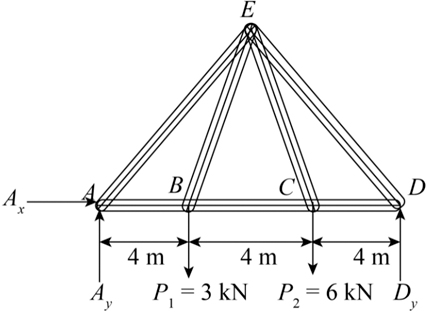
Here, ${A_x}$ is the horizontal force, ${A_y}$ is the vertical force, ${D_{\rm{y}}}$ is the reaction force.
Step 3
We will take the sum of the moments about point $A$ equal to zero to determine the equation of reaction force ${D_{\rm{y}}}$.
\[\begin{array}{c} \sum {{M_{\rm{A}}}} = 0\\ \left[ {\left( {{P_1} \cdot AB} \right) + \left\{ {{P_2} \cdot \left( {AB + BC} \right)} \right\} - \left\{ {{D_{\rm{y}}} \cdot \left( {AD} \right)} \right\}} \right] = 0 \end{array}\]Substitute the known value in the above equation.
\[\begin{array}{c} \left[ \begin{array}{l} \left( {3\;{\rm{kN}}} \right)\left( {4\;{\rm{m}}} \right)\\ + \left( {6\;{\rm{kN}}} \right)\left( {4\;{\rm{m}} + 4\;{\rm{m}}} \right)\\ - \left( {{D_{\rm{y}}}} \right)\left( {12\;{\rm{m}}} \right) \end{array} \right] = 0\\ \left( {{D_{\rm{y}}}} \right)\left( {12\;{\rm{m}}} \right) = 60\;{\rm{kN}} \cdot {\rm{m}}\\ {D_{\rm{y}}} = 5\;{\rm{kN}} \end{array}\]Step 4
We will take the sum of the moments about point $D$ equal to zero to determine the equation of vertical force ${A_{\rm{y}}}$.
\[\begin{array}{c} \sum {{M_{\rm{D}}}} = 0\\ \left[ {\left( {{A_{\rm{y}}}} \right)\left( {AD} \right) - \left( {{P_1} \cdot BD} \right) - \left\{ {{P_2} \cdot \left( {CD} \right)} \right\}} \right] = 0 \end{array}\]Substitute the known value in the above equation.
\[\begin{array}{c} \left[ \begin{array}{l} \left( {{A_{\rm{y}}}} \right)\left( {12\;{\rm{m}}} \right)\\ - \left( {3\;{\rm{kN}}} \right)\left( {8\;{\rm{m}}} \right)\\ - \left( {6\;{\rm{kN}}} \right)\left( {4\;{\rm{m}}} \right) \end{array} \right] = 0\\ \left( {{A_{\rm{y}}}} \right)\left( {12\;{\rm{m}}} \right) = 48\;{\rm{kN}} \cdot {\rm{m}}\\ {A_{\rm{y}}} = 4\;{\rm{kN}} \end{array}\]Step 5
We will take the sum of the forces in $x$ direction equal to zero to determine the forces ${A_{\rm{x}}}$.
\[\begin{array}{c} \sum {{F_{\rm{x}}}} = 0\\ {A_{\rm{x}}} = 0 \end{array}\]Step 6
According to the method of joints, we will carry out the analysis of joint $A$.
The free-body diagram of the joint $A$ is given below.
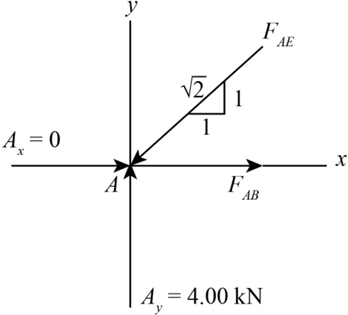
We will take the sum of the forces in $y$ direction equal to zero to determine the forces in the member $AE$.
\[\begin{array}{c} \sum {{F_{\rm{y}}}} = 0\\ {A_{\rm{y}}} - \left( {{F_{{\rm{AE}}}}} \right)\left( {\frac{1}{{\sqrt 2 }}} \right) = 0 \end{array}\]Substitute the known value in the above equation.
\[\begin{array}{c} \left( {4.0\;{\rm{kN}}} \right) - \left( {{F_{{\rm{AE}}}}} \right)\left( {\frac{1}{{\sqrt 2 }}} \right) = 0\\ \frac{{{F_{{\rm{AE}}}}}}{{\sqrt 2 }} = \left( {4.0\;{\rm{kN}}} \right)\\ {F_{{\rm{AE}}}} \approx 5.66\;{\rm{kN}}\;\left( {\rm{T}} \right) \end{array}\]We will take the sum of the forces in $x$ direction equal to zero to determine the forces in the member $AB$.
\[\begin{array}{c} \sum {{F_{\rm{x}}}} = 0\\ {F_{{\rm{AB}}}} - \left( {{F_{{\rm{AE}}}}} \right)\left( {\frac{1}{{\sqrt 2 }}} \right) = 0 \end{array}\]Substitute the known value in the above equation.
\[\begin{array}{c} \left( {{F_{{\rm{AB}}}}} \right) - \left( {4\sqrt 2 \;{\rm{kN}}} \right)\left( {\frac{1}{{\sqrt 2 }}} \right) = 0\\ {F_{{\rm{AB}}}} = \frac{{\left( {4\sqrt 2 \;{\rm{kN}}} \right)}}{{\sqrt 2 }}\\ {F_{{\rm{AB}}}} = 4.0\;{\rm{kN}}\;\left( {\rm{T}} \right) \end{array}\]Step 7
We will carry out the analysis of joint $D$.
The free-body diagram of the joint $D$ is given below.
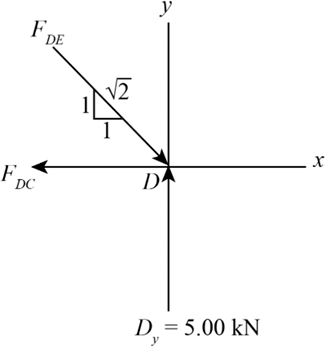
We will take the sum of the forces in $y$ direction equal to zero to determine the forces in the member $DE$.
\[\begin{array}{c} \sum {{F_{\rm{y}}}} = 0\\ {D_{\rm{y}}} - \left( {{F_{{\rm{DE}}}}} \right)\left( {\frac{1}{{\sqrt 2 }}} \right) = 0 \end{array}\]Substitute the known value in the above equation.
\[\begin{array}{c} \left( {5.0\;{\rm{kN}}} \right) - \left( {{F_{{\rm{DE}}}}} \right)\left( {\frac{1}{{\sqrt 2 }}} \right) = 0\\ \frac{{{F_{{\rm{DE}}}}}}{{\sqrt 2 }} = \left( {5.0\;{\rm{kN}}} \right)\\ {F_{{\rm{DE}}}} \approx 7.07\;{\rm{kN}}\;\left( {\rm{T}} \right) \end{array}\]We will take the sum of the forces in $x$ direction equal to zero to determine the forces in the member $DC$.
\[\begin{array}{c} \sum {{F_{\rm{x}}}} = 0\\ \left( {{F_{{\rm{DE}}}}} \right)\left( {\frac{1}{{\sqrt 2 }}} \right) - {F_{{\rm{DC}}}} = 0 \end{array}\]Substitute the known value in the above equation.
\[\begin{array}{c} \left( {5\sqrt 2 \;{\rm{kN}}} \right)\left( {\frac{1}{{\sqrt 2 }}} \right) - {F_{{\rm{DC}}}} = 0\\ {F_{{\rm{DC}}}} = \frac{{\left( {5\sqrt 2 \;{\rm{kN}}} \right)}}{{\sqrt 2 }}\\ {F_{{\rm{DC}}}} = 5.0\;{\rm{kN}}\;\left( {\rm{T}} \right) \end{array}\]Step 8
We will carry out the analysis of joint $B$.
The free-body diagram of the joint $B$ is given below.
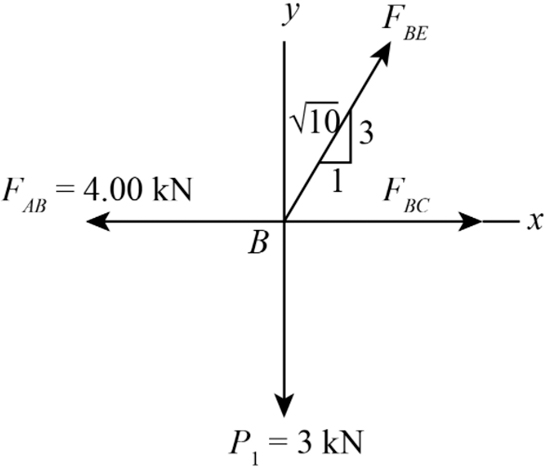
We will take the sum of the forces in $y$ direction equal to zero to determine the forces in the member $BE$.
\[\begin{array}{c} \sum {{F_{\rm{y}}}} = 0\\ \left( {{F_{{\rm{BE}}}}} \right)\left( {\frac{3}{{\sqrt {10} }}} \right) - {P_1} = 0 \end{array}\]Substitute the known value in the above equation.
\[\begin{array}{c} \left( {{F_{{\rm{BE}}}}} \right)\left( {\frac{3}{{\sqrt {10} }}} \right) - \left( {3\;{\rm{kN}}} \right) = 0\\ \frac{{3{F_{{\rm{BE}}}}}}{{\sqrt {10} }} = \left( {3\;{\rm{kN}}} \right)\\ {F_{{\rm{BE}}}} \approx 3.16\;{\rm{kN}}\;\left( {\rm{T}} \right) \end{array}\]We will take the sum of the forces in $x$ direction equal to zero to determine the forces in the member $BC$.
\[\begin{array}{c} \sum {{F_{\rm{x}}}} = 0\\ \left( {{F_{{\rm{BC}}}}} \right) + \left( {\sqrt {10} } \right)\left( {\frac{1}{{\sqrt {10} }}} \right) - {F_{{\rm{AB}}}} = 0 \end{array}\]Substitute the known value in the above equation.
\[\begin{array}{c} \left( {{F_{{\rm{BC}}}}} \right) + \left( {\sqrt {10} } \right)\left( {\frac{1}{{\sqrt {10} }}} \right) - \left( {4.0\;{\rm{kN}}} \right) = 0\\ {F_{{\rm{BC}}}} = \left( {4.0\;{\rm{kN}}} \right) - \left( {1.0\;{\rm{kN}}} \right)\\ {F_{{\rm{BC}}}} = 3.0\;{\rm{kN}}\;\left( {\rm{T}} \right) \end{array}\]Step 9
We will carry out the analysis of joint $C$.
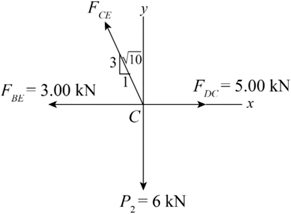
The free-body diagram of the joint $C$ is given below.
We will take the sum of the forces in $y$ direction equal to zero to determine the forces in the member $CE$.
\[\begin{array}{c} \sum {{F_{\rm{y}}}} = 0\\ \left( {{F_{{\rm{CE}}}}} \right)\left( {\frac{3}{{\sqrt {10} }}} \right) - {P_2} = 0 \end{array}\]Substitute the known value in the above equation.
\[\begin{array}{c} \left( {{F_{{\rm{CE}}}}} \right)\left( {\frac{3}{{\sqrt {10} }}} \right) - \left( {6\;{\rm{kN}}} \right) = 0\\ \frac{{3{F_{{\rm{CE}}}}}}{{\sqrt {10} }} = \left( {6\;{\rm{kN}}} \right)\\ {F_{{\rm{CE}}}} \approx 6.32\;{\rm{kN}}\;\left( {\rm{T}} \right) \end{array}\]