Engineering Mechanics: Statics and Dynamics, 14th Edition
Authors: Russell C. Hibbeler
ISBN-13: 978-0133915426
See our solution for Question 10FP from Chapter 7 from Hibbeler's Engineering Mechanics.
Problem 10FP
Step-by-Step Solution
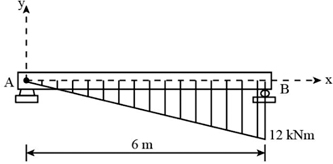
We are given the following data:
The magnitude of the moment at the point $B$ is ${M_{\rm{B}}} = 6\;{\rm{kN/m}}$.
The length of the beam is $L = 6\;{\rm{m}}$.
We are asked to determine the shear and moment as a function of $x$ and then draw the shear and moment diagram.
Step 2
We will draw the free-body diagram of the beam.
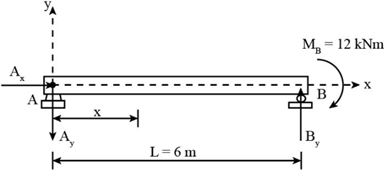
We will take the sum of the moment about the point $A$ and equate to zero to determine the force ${B_{\rm{y}}}$.
\[\begin{array}{c} \sum {{M_{\rm{A}}}} = 0\\ \left[ {{M_{\rm{B}}} - \left( {{B_{\rm{y}}}} \right)\left( L \right)} \right] = 0 \end{array}\]Substitute all the known values in the above formula.
\[\begin{array}{c} \left[ {\left( { - 12\;{\rm{kN}} \cdot {\rm{m}}} \right) - \left( {{B_{\rm{y}}}} \right)\left( {6\;{\rm{m}}} \right)} \right] = 0\\ \left[ {\left( {{B_{\rm{y}}}} \right)\left( {6\;{\rm{m}}} \right)} \right] = \left( {12\;{\rm{kN}} \cdot {\rm{m}}} \right)\\ {B_{\rm{y}}} = 2\;{\rm{kN}} \end{array}\]Step 3
We will take the sum of the forces along the $x$ axis and equate to zero to determine the force ${A_{\rm{x}}}$.
\[\begin{array}{c} \sum {{F_{\rm{x}}}} = 0\\ {A_{\rm{x}}} = 0 \end{array}\]Step 4
We will take the sum of the forces along the $y$ axis and equate to zero to determine the force ${A_{\rm{y}}}$.
\[\begin{array}{c} \sum {{F_{\rm{y}}}} = 0\\ \left[ {{A_{\rm{y}}} - {B_{\rm{y}}}} \right] = 0 \end{array}\]Substitute all the known values in the above formula.
\[\begin{array}{c} \left[ {{A_{\rm{y}}} - \left( {2\;{\rm{kN}}} \right)} \right] = 0\\ {A_{\rm{y}}} = 2\;{\rm{kN}} \end{array}\]Step 5
We will cut the beam and analyze the portion of the beam over the range $\left[ {0 \le x \le 6\;{\rm{m}}} \right]$.
We will draw the free-body diagram of the cut portion of the beam.
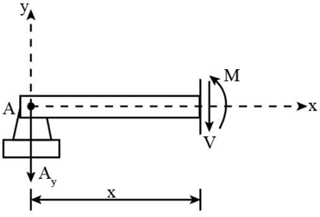
Here, $V$ is the shear force and $M$ represent the moment at the point of distance $x$ from the left end of the beam.
We will take the sum of the forces along the $y$ axis and equate to zero to determine the shear force $V$.
\[\begin{array}{c} \sum {{F_{\rm{y}}}} = 0\\ \left[ {V + {A_{\rm{y}}}} \right] = 0 \end{array}\]Substitute the known value in the above equation.
\[\begin{array}{c} \left[ {V + \left( {2\;{\rm{kN}}} \right)} \right] = 0\\ V = - 2\;{\rm{kN}} \end{array}\]Step 6
We will take the sum of the moment about the cut section and equate to zero to determine the moment $M$.
\[\begin{array}{c} \sum M = 0\\ \left[ {\left( {{A_{\rm{y}}}} \right)\left( x \right) + M} \right] = 0 \end{array}\]Substitute the known value in the above equation.
\[\begin{array}{c} \left[ {\left( {2\;{\rm{kN}}} \right)\left( x \right) + M} \right] = 0\\ M = \left( { - 2x} \right)\;{\rm{kN}} \cdot {\rm{m}} \end{array}\]Step 7
We will plot the shear force function to get the shear force diagram.
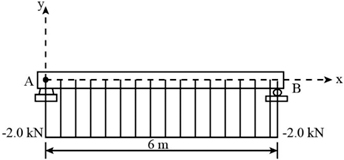
The shear force function is linear and maximum over the range of the beam,
\[{V_{{\rm{max}}}} = - 2\;{\rm{kN}}\]Step 8
We will plot the bending moment function to get the bending-moment diagram.
The value of maximum bending moment is at point $L = 6\;{\rm{m}}$.
The formula to calculate the maximum moment is given by,
\[{M_{{\rm{max}}}} = \left( V \right)\left( L \right)\]Substitute all the known values in the above formula.
\[\begin{array}{c} {M_{{\rm{max}}}} = \left( { - 2\;{\rm{kN}}} \right)\left( {6\;{\rm{m}}} \right)\\ = - 12\;{\rm{kN}} \cdot {\rm{m}} \end{array}\]