Engineering Mechanics: Statics and Dynamics, 14th Edition
Authors: Russell C. Hibbeler
ISBN-13: 978-0133915426
See our solution for Question 40P from Chapter 7 from Hibbeler's Engineering Mechanics.
Problem 40P
Step-by-Step Solution
We are given the distributed load $w = {w_0}\sin \theta $.
We are asked to determine the internal normal force, shear force, and moment acting at $\theta = 120^\circ $.
Step 2
We will draw a free body diagram of the curved rod.
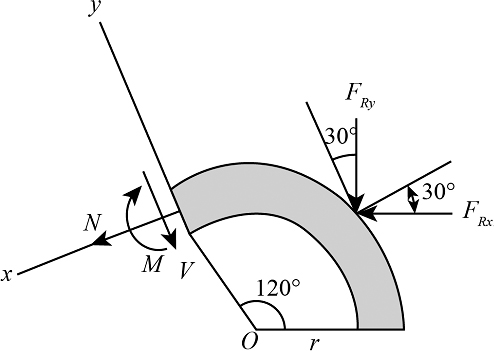
Here, ${F_{Rx}}$ is the resultant force along the $x$-axis, ${F_{Ry}}$ is the resultant force along the $y$-axis, $N$ is the internal normal force, $V$ is the shear force, $M$ is the moment, and $r$ is the radius of the rod.
Step 3
We will write the equation of the distributed load on the curved rod.
\[w = {w_0}\sin \theta \;\;...\left( 1 \right)\]Step 4
We will find the resultant distributed load in the horizontal direction.
\[{F_{Rx}} = \int\limits_0^\theta {wr\left( {d\theta } \right)\cos \theta } \]Substitute the given expression in the above equation.
\[\begin{array}{c} {F_{Rx}} = \int\limits_0^\theta {\left( {{w_0}\sin \theta } \right)r\left( {d\theta } \right)\cos \theta } \\ {F_{Rx}} = {w_0}r\int\limits_0^\theta {\left( {\sin \theta \cos \theta } \right)d\theta } \;\;\;\;\;\;\;\;\;\;\;...\left( 2 \right) \end{array}\]Step 5
Let $u = \sin \theta $, differentiate the function $u$ with respect to $\theta $.
\[\begin{array}{l} \frac{{du}}{{d\theta }} = \frac{d}{{d\theta }}\left( {\sin \theta } \right)\\ \frac{{du}}{{d\theta }} = \cos \theta \\ d\theta = \frac{{du}}{{\cos \theta }}\;\;\;\;\;\;\;\;\;\;\;\;\;\;...\left( 3 \right) \end{array}\]For lower limit:
At $\theta = 0$,
\[\begin{array}{c} u = \sin 0\\ u = 0 \end{array}\]And
For upper limit
At $\theta = \theta $,
\[u = \sin \theta \]Step 6
Substitute the given expression in equation (2).
\[\begin{array}{c} {F_{Rx}} = {w_0}r\int\limits_0^{\sin \theta } {\left( {u\cos \theta } \right)\left( {\frac{{du}}{{\cos \theta }}} \right)} \\ = {w_0}r\int\limits_0^{\sin \theta } {udu} \\ = {w_0}r\left[ {\frac{{{u^2}}}{2}} \right]_0^{\sin \theta }\\ = {w_0}r\left[ {\frac{{{{\sin }^2}\theta }}{2}} \right]\\ = \frac{1}{2}{w_0}r{\sin ^2}\theta \end{array}\]Substitute the given value in the above equation.
\[\begin{array}{c} {F_{Rx}} = \frac{1}{2}{w_0}r{\left( {\sin 120^\circ } \right)^2}\\ = 0.375{w_0}r \end{array}\]Step 7
We will find the resultant distributed load in the vertical direction.
\[{F_{Ry}} = \int\limits_0^\theta {wr\left( {d\theta } \right)\sin \theta } \]Substitute the given expression in the above equation.
\[\begin{array}{c} {F_{Ry}} = \int\limits_0^\theta {\left( {{w_0}\sin \theta } \right)r\left( {d\theta } \right)\sin \theta } \\ = {w_0}r\int\limits_0^\theta {\left( {{{\sin }^2}\theta } \right)d\theta } \\ = {w_0}r\left[ {\frac{1}{2}\theta - \frac{1}{4}\sin \left( {2\theta } \right)} \right]_0^\theta \\ = {w_0}r\left[ {\frac{1}{2}\theta - \frac{1}{4}\sin \left( {2\theta } \right)} \right]\;\;\;\;\;\;\;\;\;...\left( 4 \right) \end{array}\]Step 8
Substitute the given value in the equation (4).
\[\begin{array}{c} {F_{Ry}} = {w_0}r\left[ {\frac{1}{2}\left( {120^\circ } \right) - \frac{1}{4}\sin \left( {2\left( {120^\circ } \right)} \right)} \right]\\ = {w_0}r\left[ {\frac{1}{2}\left( {\frac{{2\pi }}{3}} \right) - \frac{1}{4}\sin \left( {240^\circ } \right)} \right]\\ \approx 1.26{w_0}r \end{array}\]Step 9
Resolve the forces along the $x$-axis to find the normal force.
\[\begin{array}{c} \sum {{F_x}} = 0\\ N + {F_{Rx}}\cos 30^\circ + {F_{Ry}}\sin 30^\circ = 0\\ N = - {F_{Rx}}\cos 30^\circ - {F_{Ry}}\sin 30^\circ \end{array}\]Substitute the given expression in the above equation.
\[\begin{array}{c} N = - \left( {0.375{w_0}r} \right)\cos 30^\circ - \left( {1.26{w_0}r} \right)\sin 30^\circ \\ \approx - 0.95{w_0}r \end{array}\]Step 10
Resolve the forces along the $y$-axis to find the shear force.
\[\begin{array}{c} \sum {{F_y}} = 0\\ - V + {F_{Rx}}\sin 30^\circ - {F_{Ry}}\cos 30^\circ = 0\\ V = {F_{Rx}}\sin 30^\circ - {F_{Ry}}\cos 30^\circ \end{array}\]Substitute the given value in the above equation.
\[\begin{array}{c} V = \left( {0.375{w_0}r} \right)\sin 30^\circ - \left( {1.26{w_0}r} \right)\cos 30^\circ \\ \approx - 0.9{w_0}r \end{array}\]Step 11
We will take the moment about the origin to find the moment.
\[\begin{array}{c} \sum {{M_O}} = 0\\ - M + Vr = 0\\ M = Vr \end{array}\]Substitute the given value in the above equation.
\[\begin{array}{c} M = \left( { - 0.9{w_0}r} \right)r\\ = - 0.9{w_0}{r^2} \end{array}\]