Engineering Mechanics: Statics and Dynamics, 14th Edition
Authors: Russell C. Hibbeler
ISBN-13: 978-0133915426
See our solution for Question 84P from Chapter 7 from Hibbeler's Engineering Mechanics.
Problem 84P
Step-by-Step Solution
We are given the two loads of $3\;{{{\rm{kN}}} \mathord{\left/ {\vphantom {{{\rm{kN}}} {\rm{m}}}} \right. } {\rm{m}}}$ and at a distance of $3\;{\rm{m}}$ each.
We are asked to draw the shear and moment diagrams for the beam.
Step 2
The free-body diagram of the beam can be drawn as:
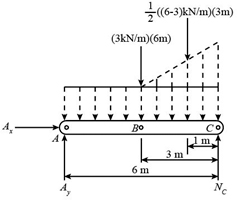
Here, ${A_x}$ is the horizontal component of support A, ${A_y}$ is the vertical component of support A and ${N_C}$ is the normal force reaction at support C.
On taking the moment about point A, we get:
\[\begin{array}{c} \sum {M_A} = 0\\ \left[ \begin{array}{l} \left\{ {{N_C} \times \left( {6\;{\rm{m}}} \right)} \right\} - \left\{ {\left( {3\;{{{\rm{kN}}} \mathord{\left/ {\vphantom {{{\rm{kN}}} {\rm{m}}}} \right. } {\rm{m}}}} \right) \times \left( {6\;{\rm{m}}} \right) \times \left( {\frac{{6\;{\rm{m}}}}{2}} \right)} \right\} - \\ \left\{ {\left( {\frac{1}{2} \times \left( {6 - 3} \right)\;{{{\rm{kN}}} \mathord{\left/ {\vphantom {{{\rm{kN}}} {\rm{m}}}} \right. } {\rm{m}}} \times \left( {3\;{\rm{m}}} \right) \times \left( {3\;{\rm{m}} + \frac{{2 \times 3\;{\rm{m}}}}{3}} \right)} \right)} \right\} \end{array} \right] = 0\\ {N_C} \times \left( {6\;{\rm{m}}} \right) = \left( {76.5\;{\rm{kN}} \cdot {\rm{m}}} \right)\\ {N_C} = 12.75\;{\rm{kN}} \end{array}\]On balancing the horizontal forces, we get:
\[\begin{array}{c} \sum {F_H} = 0\\ {A_x} = 0 \end{array}\]On taking the moment about point C, we get:
\[\begin{array}{c} \sum {M_C} = 0\\ \left[ \begin{array}{l} {A_x} \times 0 + \left\{ {\left( {\frac{1}{2} \times \left( {6 - 3} \right)\;{{{\rm{kN}}} \mathord{\left/ {\vphantom {{{\rm{kN}}} {\rm{m}}}} \right. } {\rm{m}}} \times \left( {3\;{\rm{m}}} \right) \times \left( {1\;{\rm{m}}} \right)} \right)} \right\} + \\ \left\{ {\left( {3\;{{{\rm{kN}}} \mathord{\left/ {\vphantom {{{\rm{kN}}} {\rm{m}}}} \right. } {\rm{m}}}} \right) \times \left( {6\;{\rm{m}}} \right) \times \left( {\frac{{6\;{\rm{m}}}}{2}} \right)} \right\} - {A_y} \times \left( {6\;{\rm{m}}} \right) \end{array} \right] = 0\\ \left( {58.5\;{\rm{kN}} \cdot {\rm{m}}} \right) = {A_y} \times \left( {6\;{\rm{m}}} \right)\\ {A_y} = 9.75\;{\rm{kN}} \end{array}\]Step 3
Now. Consider the similar triangles $BQP$ and $BCQ$ as shown below,
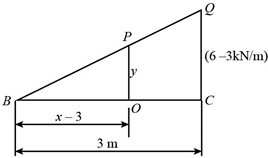
Consider the section at a distance x from the point A and then, we can draw the free-body diagram of the left segment of the beam as:
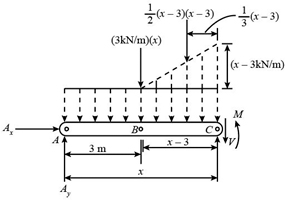
On balancing the vertical forces, we get:
\[\begin{array}{c} \sum {F_V} = 0\\ {A_y} - \left[ {\left( {3\;{{{\rm{kN}}} \mathord{\left/ {\vphantom {{{\rm{kN}}} {\rm{m}}}} \right. } {\rm{m}}}} \right) \times x} \right] - \left[ {\frac{1}{2} \times \left( {x - 3} \right) \times \left( {x - 3} \right)} \right] - V = 0\\ \left( {9.75\;{\rm{kN}}} \right) - \left[ {\left( {3\;{{{\rm{kN}}} \mathord{\left/ {\vphantom {{{\rm{kN}}} {\rm{m}}}} \right. } {\rm{m}}}} \right) \times x} \right] - \left[ {\frac{1}{2} \times \left( {x - 3} \right) \times \left( {x - 3} \right)} \right] = V \end{array}\]On further solving the above equation, we get:
\[\begin{array}{c} \left( {9.75} \right) - \left( {3x} \right) - \left[ {\frac{{{x^2}}}{2} + 4.5 - 3x} \right]\;{\rm{kN}} = V\\ V = \left[ {5.25 - \frac{1}{2}{x^2}} \right]\;{\rm{kN}} \end{array}\] …. (1)On taking the moment about point O, we get:
\[\begin{array}{l} \sum {M_O} = 0\\ M + \left[ {\frac{1}{2} \times \left( {x - 3} \right) \times \left( {x - 3} \right) \times \left( {\frac{1}{3} \times \left( {x - 3} \right)} \right)} \right] + \left[ {\left( {3x} \right) \times \left( {\frac{x}{2}} \right)} \right] - \left[ {{A_y} \times x} \right] = 0 \end{array}\]Substitute the value of ${A_y}$ in the above expression, we get:
\[\begin{array}{c} M = \left[ { - \frac{1}{6} \times {{\left( {x - 3} \right)}^3}} \right] - \left[ {\frac{{3{x^2}}}{2}} \right] + \left[ {\left( {9.75\;{\rm{kN}}} \right) \times x} \right]\\ M = \left( { - \frac{1}{6}{x^3} + 5.25x + 4.5} \right)\;{\rm{kN}} \cdot {\rm{m}} \end{array}\] …. (2)Step 4
We know that, the maximum bending moment occurs on the beam where the shear force is zero. Hence, $V = 0$.
Substitute the values in the equation (1), we get:
\[\begin{array}{c} 0 = \left[ {5.25 - \frac{1}{2} \times {x^2}} \right]\\ {x^2}{\rm{ = 10}}{\rm{.5}}\\ x = \sqrt {10.5} \;{\rm{m}} \end{array}\]Substitute the values in equation (2), we get:
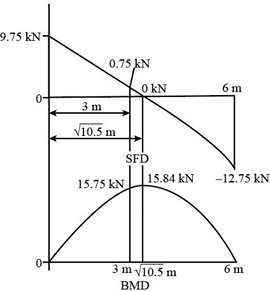
\[\begin{array}{c} M = \left( { - \frac{1}{6} \times {{\left( {\sqrt {10.5} } \right)}^3} + 5.25 \times \left( {\sqrt {10.5} } \right) + 4.5} \right)\;{\rm{kN}} \cdot {\rm{m}}\\ M = \left( { - 5.67 + 17.01 + 4.5} \right)\;{\rm{kN}} \cdot {\rm{m}}\\ M = 15.84\;{\rm{kN}} \cdot {\rm{m}} \end{array}\]Now, for $x = 3$, we can calculate the shear force at point B by substituting the values in equation (1) as:
\[\begin{array}{c} {V_B} = \left[ {5.25 - \frac{1}{2} \times {{\left( 3 \right)}^2}} \right]\;{\rm{kN}}\\ {V_B} = 0.75\;{\rm{kN}} \end{array}\]Similarly, for $x = 3$, we can calculate the moment at point B by substituting the values in equation (2) as:
\[\begin{array}{c} {M_B} = \left( { - \frac{1}{6} \times {{\left( 3 \right)}^3} + 5.25 \times \left( 3 \right) + 4.5} \right)\;{\rm{kN}} \cdot {\rm{m}}\\ {M_B} = \left( { - 4.5 + 15.75 + 4.5} \right)\;{\rm{kN}} \cdot {\rm{m}}\\ {M_B} = 15.75\;{\rm{kN}} \cdot {\rm{m}} \end{array}\]Step 5
For $x = 6$, we can calculate the shear force at point C by substituting the values in equation (1) as:
\[\begin{array}{c} {V_C} = \left[ {5.25 - \frac{1}{2} \times {{\left( 6 \right)}^2}} \right]\;{\rm{kN}}\\ {V_C} = - 12.75\;{\rm{kN}} \end{array}\]Similarly, for $x = 6$, we can calculate the moment at point C by substituting the values in equation (2) as:
\[\begin{array}{c} {M_C} = \left( { - \frac{1}{6} \times {{\left( 6 \right)}^3} + 5.25 \times \left( 6 \right) + 4.5} \right)\;{\rm{kN}} \cdot {\rm{m}}\\ {M_C} = \left( { - 36 + 31.5 + 4.5} \right)\;{\rm{kN}} \cdot {\rm{m}}\\ {M_C} = 0 \end{array}\]Hence, the shear force and the bending moment diagram can be drawn as: