Engineering Mechanics: Statics and Dynamics, 14th Edition
Authors: Russell C. Hibbeler
ISBN-13: 978-0133915426
See our solution for Question 103P from Chapter 8 from Hibbeler's Engineering Mechanics.
Problem 103P
Step-by-Step Solution
We have given the following values:
The weight of block A is ${W_A} = 50\;{\rm{lb}}$.
The weight of block B is ${W_B} = 30\;{\rm{lb}}$.
The coefficient of friction between block A and B is ${\mu _{BA}} = 0.6$.
The coefficient of friction between block B and plane C is ${\mu _{AC}} = 0.4$.
The coefficient of friction between rope and pulley is $\mu = 0.5$.
We are asked to calculate the greatest weight of block D without causing motion.
Step 2
First, we assume that there is no slipping occurs between block A and B.
Draw a combined free-body diagram of block A and B.
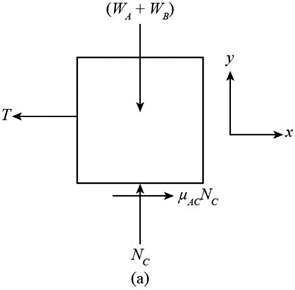
Here, T is the tension in the rope attached to the block and ${N_C}$ is the normal reaction applied by plane C.
Step 3
Consider figure (a) and apply equilibrium equation of forces along the y-axis:
\[\begin{array}{c} \sum {{F_y}} = 0\\ {N_C} - \left( {{W_A} + {W_B}} \right) = 0\\ {N_C} = {W_A} + {W_B} \end{array}\]Substitute the value of ${W_A}$ and ${W_B}$ in the above equation:
\[\begin{array}{c} {N_C} = \left( {50\;{\rm{lb}}} \right) + \left( {30\;{\rm{lb}}} \right)\\ = 80\;{\rm{lb}} \end{array}\]Step 4
Consider figure (a) and apply equilibrium equation of forces along the x-axis:
\[\begin{array}{c} \sum {{F_x}} = 0\\ {\mu _{AC}}{N_C} - T = 0\\ T = {\mu _{AC}}{N_C} \end{array}\]Substitute the value of ${\mu _{AC}}$ and ${N_C}$ in the above equation:
\[\begin{array}{c} T = \left( {0.4} \right)\left( {80\,{\rm{lb}}} \right)\\ T = 32\;{\rm{lb}} \end{array}\]Step 5
Draw a free-body diagram of block B (for no slipping).
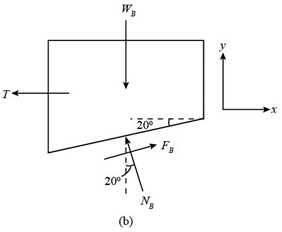
Here, ${N_B}$ is the normal reaction acting on block B and ${F_B}$ is the friction force acting on block B.
Step 6
Consider figure (b) and apply equilibrium equation of forces along the y-axis:
\[\begin{array}{c} \sum {{F_y}} = 0\\ {N_B}\cos 20^\circ + {F_B}\sin 20^\circ - {W_B} = 0\\ {N_B}\cos 20^\circ + {F_B}\sin 20^\circ = {W_B} \end{array}\]Substitute the value of ${W_B}$ in the above equation:
\[\begin{array}{c} {N_B}\cos 20^\circ + {F_B}\sin 20^\circ = 30\;{\rm{lb}}\\ {N_B} = \frac{{30\;{\rm{lb}} - {F_B}\sin 20^\circ }}{{\cos 20^\circ }} \end{array}\]……(1)Step 7
Consider figure (b) and apply equilibrium equation of forces along the x-axis:
\[\begin{array}{c} \sum {{F_x}} = 0\\ {F_B}\cos 20^\circ - {N_B}\sin 20^\circ - T = 0\\ {F_B}\cos 20^\circ - {N_B}\sin 20^\circ = T \end{array}\]Substitute the value of T in the above equation:
\[{F_B}\cos 20^\circ - {N_B}\sin 20^\circ = 32\;{\rm{lb}}\]Step 8
Substitute the value of ${N_B}$ from equation (1) in the above equation:
\[\begin{array}{c} {F_B}\cos 20^\circ - \left( {\frac{{30\;{\rm{lb}} - {F_B}\sin 20^\circ }}{{\cos 20^\circ }}} \right)\sin 20^\circ = 32\;{\rm{lb}}\\ {F_B}{\left( {\cos 20^\circ } \right)^2} - \left( {30\;{\rm{lb}} - {F_B}\sin 20^\circ } \right)\sin 20^\circ = 32\;{\rm{lb}} \times \cos 20^\circ \\ {F_B} = 40.33\;{\rm{lb}} \end{array}\]Substitute the value of ${F_B}$ in equation (1):
\[\begin{array}{l} {N_B} = \frac{{30\;{\rm{lb}} - \left( {40.33\;{\rm{lb}}} \right)\sin 20^\circ }}{{\cos 20^\circ }}\\ {N_B} = 17.25\;{\rm{lb}} \end{array}\]Step 9
The maximum friction force ${f_{\max }}$ acting on block B is given by:
\[{f_{\max }} = {\mu _{BA}}{N_B}\]Substitute the value of ${\mu _{BA}}$ and ${N_B}$ in the above equation:
\[\begin{array}{c} {f_{\max }} = \left( {0.6} \right)\left( {17.25\;{\rm{lb}}} \right)\\ = 10.35\;{\rm{lb}} \end{array}\]Since, ${F_B} > {f_{\max }}$, slipping does occur between blocks A and B. Therefore, our previous assumption was not good.
Step 10
Draw a free-body diagram of block B (for slipping condition).
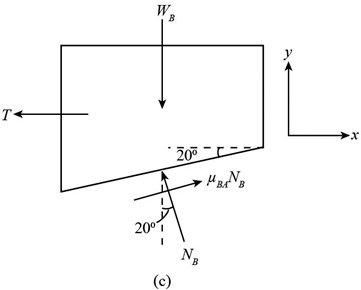
Here, ${N_B}$ is the normal reaction acting on block B and ${F_B}$ is the friction force acting on block B.
Step 11
Consider figure (c) and apply equilibrium equation of forces along the y-axis:
\[\begin{array}{c} \sum {{F_y}} = 0\\ {N_B}\cos 20^\circ + {\mu _{BA}}{N_B}\sin 20^\circ - {W_B} = 0 \end{array}\]Substitute the value of ${\mu _{BA}}$ and ${W_B}$ in the above equation:
\[\begin{array}{c} {N_B}\cos 20^\circ + \left( {0.6} \right){N_B}\sin 20^\circ - \left( {30\;{\rm{lb}}} \right) = 0\\ {N_B} = 26.20\;{\rm{lb}} \end{array}\]Step 12
Consider figure (c) and apply equilibrium equation of forces along the x-axis:
\[\begin{array}{c} \sum {{F_x}} = 0\\ {\mu _{BA}}{N_B}\cos 20^\circ - {N_B}\sin 20^\circ - T = 0\\ T = {\mu _{BA}}{N_B}\cos 20^\circ - {N_B}\sin 20^\circ \end{array}\]Substitute the value of ${\mu _{BA}}$ and ${N_B}$ in the above equation:
\[\begin{array}{c} T = \left( {0.6} \right)\left( {26.20\;{\rm{lb}}} \right)\cos 20^\circ - \left( {26.20\;{\rm{lb}}} \right)\sin 20^\circ \\ = 5.81\;{\rm{lb}} \end{array}\]Step 13
Now, draw a labeled diagram of the pulley and ropes over it.
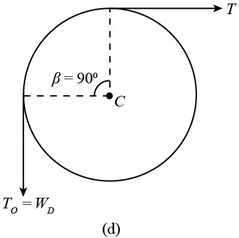
Here, ${T_o}$ is the tension in the rope segment connected between the block D and pulley, ${W_D}$ is the weight of block D, and $\beta $ is the angle of contact.
Step 14
The tension in the rope segment connected between the block D and pulley will be equal to the weight of block D. Then,
\[{T_o} = {W_D}\]The angle of contact of the rope is:
\[\begin{array}{c} \beta = 90^\circ \\ = 90^\circ \times \frac{{2\pi \;{\rm{rad}}}}{{360^\circ }}\\ = 0.5\pi \;{\rm{rad}} \end{array}\]Step 15
The relation between the tensions in the rope is given by:
\[{T_o} = T{e^{\mu \beta }}\]Substitute the value of parameters in the above equation:
\[\begin{array}{c} {W_D} = \left( {5.81\;{\rm{lb}}} \right){e^{\left( {0.5} \right)\left( {0.5\pi \;{\rm{rad}}} \right)}}\\ = 12.7\;{\rm{lb}} \end{array}\]