Engineering Mechanics: Statics and Dynamics, 14th Edition
Authors: Russell C. Hibbeler
ISBN-13: 978-0133915426
See our solution for Question 105P from Chapter 8 from Hibbeler's Engineering Mechanics.
Problem 105P
Step-by-Step Solution
We have given the following values:
The mass of each cylinder D and E is ${m_D} = {m_E} = m = 10\;{\rm{kg}}$.
The coefficient of static friction between the cord and the peg is ${\mu _s} = 0.1$.
We are asked to calculate the largest angle $\theta $ so that the cord does not slip over the peg.
Step 2
The weight of each cylinder (D and E) is given by:
\[W = mg\]Substitute 10 kg for m and $9.81\,{\rm{m}}/{{\rm{s}}^{\rm{2}}}$ for g in the above equation:
\[\begin{array}{c} W = \left( {10\;{\rm{kg}}} \right)\left( {9.81\;{\rm{m}}/{{\rm{s}}^2}} \right) \times \frac{{1\;{\rm{N}}}}{{1\;{\rm{kg}} \cdot {\rm{m}}/{{\rm{s}}^2}}}\\ = 98.1\;{\rm{N}} \end{array}\]Step 3
Since pulley B is smooth, the tension in the cord between pegs A and C remains constant.
Draw a free-body diagram of point B.
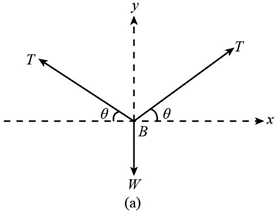
Here, T is the tension in the cord AB and BC.
Step 4
Consider figure (a) and apply equilibrium equation of forces along the y-axis:
\[\begin{array}{c} \sum {{F_y}} = 0\\ T\sin \theta + T\sin \theta - W = 0\\ 2T\sin \theta = W\\ T = \frac{W}{{2\sin \theta }} \end{array}\]Substitute the value of W in the above equation:
\[\begin{array}{c} T = \frac{{98.1\;{\rm{N}}}}{{2\sin \theta }}\\ = \frac{{49.05\;{\rm{N}}}}{{\sin \theta }} \end{array}\]Step 5
Draw a labelled diagram of peg C.
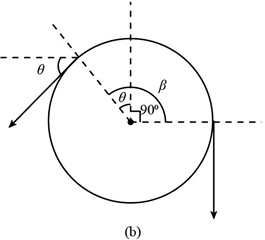
Here, $\beta $ is the angle of contact of cord with the peg.
Step 6
Consider the figure (b), the angle of contact of the cord is given by:
\[\beta = \frac{\pi }{2} + \theta \]Step 7
In the case where cylinder E is on the verge of ascending, the tension ${T_1}$ in the cord connected between peg C and cylinder E will be equal to the weight of cylinder E. Then,
\[{T_1} = W = 98.1\;{\rm{N}}\]Also, on the verge of ascending, consider:
\[{T_2} = T = \frac{{49.05\;{\rm{N}}}}{{\sin \theta }}\]Step 9
The relation between the tensions in the cord is given by:
\[{T_2} = {T_1}{e^{{\mu _s}\beta }}\]Substitute the value of parameters in the above equation:
\[\begin{array}{c} \frac{{49.05\;{\rm{N}}}}{{\sin \theta }} = \left( {98.1\;{\rm{N}}} \right){e^{\left( {0.1} \right)\left( {\frac{\pi }{2} + \theta } \right)}}\\ \ln \left( {\frac{{0.5}}{{\sin \theta }}} \right) = \left( {0.1} \right)\left( {\frac{\pi }{2} + \theta } \right) \end{array}\]On solving the above equation by trial and error method, we get:
\[\begin{array}{c} \theta = 0.4221\;{\rm{rad}}\\ = 0.4221\;{\rm{rad}} \times \frac{{360^\circ }}{{2\pi \;{\rm{rad}}}}\\ = 24.2^\circ \end{array}\]Step 10
In the case, the cylinder E is on the verge of descending. The tension ${T_2}$ in the cord connected between peg C and cylinder E will be equal to the weight of cylinder E. Then,
\[{T_2} = W = 98.1\;{\rm{N}}\]Also, on the verge of ascending, consider:
\[{T_1} = T = \frac{{49.05\;{\rm{N}}}}{{\sin \theta }}\]Step 11
The relation between the tensions in the cord is given by:
\[{T_2} = {T_1}{e^{{\mu _s}\beta }}\]Substitute the value of parameters in the above equation:
\[\begin{array}{c} \left( {98.1\;{\rm{N}}} \right) = \frac{{49.05\;{\rm{N}}}}{{\sin \theta }}{e^{\left( {0.1} \right)\left( {\frac{\pi }{2} + \theta } \right)}}\\ \ln \left( {2\sin \theta } \right) = \left( {0.1} \right)\left( {\frac{\pi }{2} + \theta } \right) \end{array}\]On solving the above equation by trial and error method, we get:
\[\begin{array}{c} \theta = 0.6764\;{\rm{rad}}\\ = 0.6764\;{\rm{rad}} \times \frac{{360^\circ }}{{2\pi \;{\rm{rad}}}}\\ = 38.75^\circ \end{array}\]Step 12
Thus, the range of $\theta $ at which the cord does not slip on the peg C is:
\[24.2^\circ < \theta < 38.75^\circ \]So, the largest angle for which the cord does not slip over the peg is ${\theta _{\max }} = 38.75^\circ $.