Engineering Mechanics: Statics and Dynamics, 14th Edition
Authors: Russell C. Hibbeler
ISBN-13: 978-0133915426
See our solution for Question 31P from Chapter 8 from Hibbeler's Engineering Mechanics.
Problem 31P
Step-by-Step Solution
We are given the following data:
The weight of block $A$ is ${W_A} = 10\;{\rm{lb}}$.
The weight of block $B$ is ${W_B} = 6\;{\rm{lb}}$.
The coefficient of static friction between the surface and block $A$ is ${\mu _A} = 0.15$.
The coefficient of static friction between the surface and block $B$ is ${\mu _B} = 0.25$.
The stiffness of spring is $k = 2\;{\rm{lb/ft}}$.
We are asked to determine the incline angle $\theta $ which will cause motion of one of the blocks and the friction force under each of the blocks.
Step 2
Since neither block $A$ nor block $B$ is moving yet, the spring force would be equal to zero $\left( {{F_{Sp}} = 0\;{\rm{lb}}} \right)$.
We will draw a free body diagram of the block $A$.
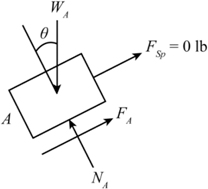
Here, ${F_{Sp}}$ represent the spring force, ${N_A}$ is the normal reaction force at block $A$ , ${W_A}$ is the weight of the block $A$ and ${F_A}$ is the friction force at block $A$.
Step 3
We will take the sum of the force along the horizontal direction and equate to zero.
\[\begin{array}{c} \sum {{F_x}} = 0\\ \left[ {{F_{Sp}} + {F_A} - \left( {{W_A}\sin \theta } \right)} \right] = 0 \end{array}\]Substitute all the known values in the above equation.
\[\begin{array}{c} \left[ \begin{array}{l} 0 + {F_A}\\ - \left( {10\;{\rm{lb}}} \right)\left( {\sin \theta } \right) \end{array} \right] = 0\\ {F_A} = \left[ {10\sin \theta } \right]\;{\rm{lb}} \end{array}\]Step 4
We will take the sum of the force along the vertical direction and equate to zero.
\[\begin{array}{c} \sum {{F_y}} = 0\\ \left[ {{N_A} - \left( {{W_A}\cos \theta } \right)} \right] = 0 \end{array}\]Substitute all the known values in the above equation.
\[\begin{array}{c} \left[ {{N_A} - \left( {10\;{\rm{lb}}} \right)\left( {\cos \theta } \right)} \right] = 0\\ {N_A} = \left[ {10\cos \theta } \right]\;{\rm{lb}} \end{array}\]Step 5
We will draw the free-body diagram of the block $B$.
Here, ${N_B}$ is the normal reaction force at block $B$ , ${W_B}$ is the weight of the block $B$ and ${F_B}$ is the friction force at block $B$.
We will take the sum of the force along the horizontal direction and equate to zero.
\[\begin{array}{c} \sum {{F_x}} = 0\\ \left[ {{F_B} - {F_{Sp}} - \left( {{W_B}\sin \theta } \right)} \right] = 0 \end{array}\]Substitute all the known values in the above equation.
\[\begin{array}{c} \left[ \begin{array}{l} {F_B} - \left( {0\;{\rm{lb}}} \right)\\ - \left( {6\;{\rm{lb}}} \right)\left( {\sin \theta } \right) \end{array} \right] = 0\\ {F_B} = \left[ {6\sin \theta } \right]\;{\rm{lb}} \end{array}\]Step 6
We will take the sum of the force along the vertical direction and equate to zero.
\[\begin{array}{c} \sum {{F_y}} = 0\\ \left[ {{N_B} - \left( {{W_B}\cos \theta } \right)} \right] = 0 \end{array}\]Substitute all the known values in the above equation.
\[\begin{array}{c} \left[ {{N_B} - \left( {6\;{\rm{lb}}} \right)\left( {\cos \theta } \right)} \right] = 0\\ {N_B} = \left[ {6\cos \theta } \right]\;{\rm{lb}} \end{array}\]Step 7
If we assume that the block $A$ and $B$ are on the verge to move, slipping would have to occur at point $A$ and $B$.
The formula to calculate the friction force ${F_A}$ is given by,
\[{F_A} = \left( {{\mu _A}} \right)\left( {{N_A}} \right)\]Substitute all the known values in the above formula.
\[\begin{array}{c} {F_A} = \left[ {\left( {0.15} \right)\left( {10\cos \theta } \right)} \right]\;{\rm{lb}}\\ = \left[ {1.5\cos \theta } \right]\;{\rm{lb}} \end{array}\]Step 8
Substitute the value ${F_A} = \left[ {1.5\cos \theta } \right]\;{\rm{lb}}$ in the equation ${F_A} = \left[ {10\sin \theta } \right]\;{\rm{lb}}$ to obtain $\theta $.
\[\begin{array}{c} \left( {1.5\cos \theta } \right){\rm{lb}} = \left[ {10\sin \theta } \right]\;{\rm{lb}}\\ \tan \theta = \left( {\frac{{1.5\;{\rm{lb}}}}{{10\;{\rm{lb}}}}} \right)\\ \tan \theta = 0.15\\ \theta = 8.53^\circ \end{array}\]Step 9
Substitute the value $\theta \approx 8.53^\circ $ in the equation ${F_A} = \left[ {10\sin \theta } \right]\;{\rm{lb}}$ to obtain ${F_A}$.
\[\begin{array}{c} {F_A} = \left[ {10\sin 8.53^\circ } \right]\;{\rm{lb}}\\ {\rm{ = 1}}{\rm{.48}}\;{\rm{lb}} \end{array}\]Step 10
Substitute the value $\theta \approx 8.53^\circ $ in the equation ${N_B} = \left[ {6\cos \theta } \right]\;{\rm{lb}}$ to obtain ${N_B}$.
\[\begin{array}{c} {N_B} = \left[ {6\cos 8.53^\circ } \right]\;{\rm{lb}}\\ \approx \;{\rm{5}}{\rm{.934}}\;{\rm{lb}} \end{array}\]Step 11
Substitute the value $\theta \approx 8.53^\circ $ in the equation ${F_B} = \left[ {6\sin \theta } \right]\;{\rm{lb}}$ to obtain ${F_B}$.
\[\begin{array}{c} {F_B} = \left[ {6\sin 8.53^\circ } \right]\;{\rm{lb}}\\ {\rm{ = }}\left( {0.89} \right)\;{\rm{lb}} \end{array}\]Step 12
The formula to calculate the maximum value of ${F_B}$ is given by,
\[{\left( {{F_B}} \right)_{\max }} = {\mu _B}{N_B}\]Substitute all the known values in the above formula.
\[\begin{array}{c} {\left( {{F_B}} \right)_{{\rm{max}}}} = \left( {0.25} \right)\left( {5.934\;{\rm{lb}}} \right)\\ = 1.483\;{\rm{lb}} \end{array}\]Since ${\left( {{F_B}} \right)_{\max }} = \left( {1.483\;{\rm{lb}}} \right) > {F_B}$, block $B$ does not slip. Therefore, the above assumption is correct.
So, $\theta = 8.53^\circ $, ${F_A} = 1.48\;{\rm{lb}}$ and ${F_B} = 0.89\;{\rm{lb}}$.