Engineering Mechanics: Statics and Dynamics, 14th Edition
Authors: Russell C. Hibbeler
ISBN-13: 978-0133915426
See our solution for Question 53P from Chapter 8 from Hibbeler's Engineering Mechanics.
Problem 53P
Step-by-Step Solution
The following data is given:
The weight of the uniform concrete block is ${W_1} = 300{\rm{ lb}}$.
The weight of the wheel is ${W_2} = 150{\rm{ lb}}$.
The coefficients of static friction at point $A$ is ${\mu _A} = 0.2$.
The coefficients of static friction at point $B$ is ${\mu _B} = 0.3$.
The coefficient of static friction between the concrete block and the floor is $\mu = 0.4$.
We are asked to determine the smallest couple moment that can be applied to the wheel that will cause impending motion.
Step 2
The free-body diagram of the concrete is given by,
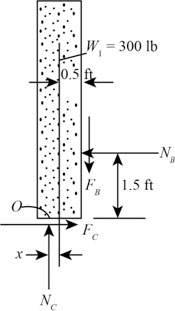
At equilibrium condition, balancing all the forces acting on the concrete in the horizontal direction, we have,
\[\begin{array}{c} {F_C} - {N_B} = 0\\ {F_C} = {N_B} \end{array}\] … (1)Similarly, balancing all the forces acting on the concrete in the vertical direction, we have,
\[\begin{array}{c} {N_C} - {F_B} - {W_1} = 0\\ {N_C} - {F_B} - 300{\rm{ lb}} = 0 \end{array}\] … (2)Taking moments about the point $O$, we have,
\[\begin{array}{c} {N_B} \times \left( {1.5{\rm{ ft}}} \right) - {W_1} \times x - {F_B}\left( {0.5{\rm{ ft}} + x} \right) = 0\\ {N_B} \times \left( {1.5{\rm{ ft}}} \right) - 300{\rm{ lb}} \times x - {F_B}\left( {0.5{\rm{ ft}} + x} \right) = 0 \end{array}\] … (3)Step 3
The free-body diagram of the wheel is given by,
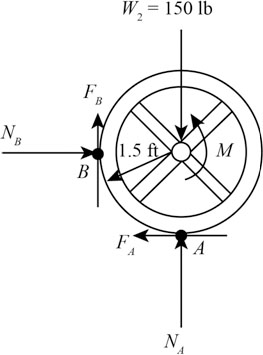
At equilibrium condition, balancing all the forces acting on the wheel in the horizontal direction, we have,
\[\begin{array}{c} {N_B} - {F_A} = 0\\ {N_B} = {F_A} \end{array}\] … (4)Similarly, balancing all the forces acting on the wheel in the vertical direction, we have,
\[\begin{array}{c} {N_A} + {F_B} - {W_2} = 0\\ {N_A} + {F_B} - 150{\rm{ lb}} = 0 \end{array}\] … (5)Taking moments about the point $A$, we have,
\[M - {N_B} \times \left( {1.5{\rm{ ft}}} \right) - {F_B}\left( {1.5{\rm{ ft}}} \right) = 0\] … (6)Step 4
Assuming the slipping occurs at points $A$ and $B$ due to the motion of the wheel, the friction force acting at point $A$ is given by,
\[\begin{array}{l} {F_A} = {\mu _A}{N_A}\\ {F_A} = 0.2{N_A} \end{array}\]Similarly, the friction force acting at point $B$ is given by,
\[\begin{array}{c} {F_B} = {\mu _B}{N_B}\\ {F_B} = {\mu _B}{F_A}\\ {F_B} = 0.3 \times 0.2{N_A}\\ {F_B} = 0.06{N_A} \end{array}\]On substituting ${N_B} = {F_A}$ in the above expression, we get,
\[{F_B} = 0.3{F_A}\]From equation (5), we have,
\[\begin{array}{c} {N_A} + 0.06{N_A} - 150{\rm{ lb}} = 0\\ 1.06{N_A} - 150{\rm{ lb}} = 0\\ {N_A} = 141.51{\rm{ lb}} \end{array}\]Then, the friction force at point $B$ is given by,
\[\begin{array}{c} {F_B} = 0.06 \times 141.51{\rm{ lb}}\\ {F_B} = 8.491{\rm{ lb}} \end{array}\]Similarly, the reaction force at point $B$ using the friction law, is given by,
\[\begin{array}{c} {\rm{8}}{\rm{.491 lb}} = 0.3{N_B}\\ {N_B} = 28.30{\rm{ lb}} \end{array}\]Similarly, the friction force at point $A$ is given by,
\[\begin{array}{l} {F_A} = {N_B}\\ {F_A} = 28.30{\rm{ lb}} \end{array}\]From equation (1), we have,
\[\begin{array}{l} {F_C} = {N_B}\\ {F_C} = 28.30{\rm{ lb}} \end{array}\]Step 5
The couple moment using the equation (6) can be given as,
\[\begin{array}{c} M - {N_B} \times \left( {1.5{\rm{ ft}}} \right) - {F_B} \times \left( {1.5{\rm{ ft}}} \right) = 0\\ M - 28.30{\rm{ lb}} \times \left( {1.5{\rm{ ft}}} \right) - 8.491{\rm{ lb}} \times \left( {1.5{\rm{ ft}}} \right) = 0\\ M = 55.19{\rm{ lb}} \cdot {\rm{ft}} \end{array}\]Substituting these values in equation (3), we get,
\[\begin{array}{c} 28.30{\rm{ lb}} \times \left( {1.5{\rm{ ft}}} \right) - 300{\rm{ lb}} \times x - 8.491{\rm{ lb}} \times \left( {0.5{\rm{ ft}} + x} \right) = 0\\ 42.45{\rm{ lb}} \cdot {\rm{ft}} - 300x{\rm{ lb}} - 4.245{\rm{ lb}} \cdot {\rm{ft}} - 8.491x{\rm{ lb}} = 0\\ 38.2045{\rm{ lb}} \cdot {\rm{ft}} = 308.491x{\rm{ lb}}\\ x = 0.1238{\rm{ ft}} \end{array}\]Since, the value of $x$ is less than the half of the width of the concrete block. It means that the concrete block does not tip when a moment is applied. Hence our assumption was correct.
Also, using the friction law, the maximum force required for the slipping at point $C$ to occur, is given by,
\[\begin{array}{l} {\left( {{F_C}} \right)_{\max }} = {\mu _C}{N_C}\\ {\left( {{F_C}} \right)_{\max }} = {\mu _C}\left( {{W_1} + {F_B}} \right)\\ {\left( {{F_C}} \right)_{\max }} = 0.4\left( {300{\rm{ lb}} + 8.491{\rm{ lb}}} \right)\\ {\left( {{F_C}} \right)_{\max }} = 123.396{\rm{ lb}} \end{array}\]Comparing the friction values at point $C$, we have,
\[{F_C} < {\left( {{F_C}} \right)_{\max }}\]So, the slipping of point $C$ does not occur and our assumption is correct.