Engineering Mechanics: Statics and Dynamics, 14th Edition
Authors: Russell C. Hibbeler
ISBN-13: 978-0133915426
See our solution for Question 54P from Chapter 8 from Hibbeler's Engineering Mechanics.
Problem 54P
Step-by-Step Solution
We are given a man climbing a ladder at a position shown in the diagram. The following data is given:
The mass of the man is $m = 75{\rm{ kg}}$.
The coefficient of static friction at $A$ and $B$ is ${\mu _s} = 0.3$.
We are asked to determine the greatest angle $\theta $ so that the ladder does notslip when it supports the man in the position shown.
Step 2
The free-body diagram of the link $AC$ of the ladder is given by,
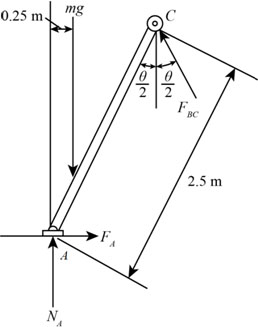
Here, $\theta $ is the angle of the ladder at the instant shown, ${F_A}$ is the friction force acting at support $A$, ${N_A}$ is the reaction force at $A$ and ${F_{BC}}$ is the force acting on link $BC$.
Step 3
The free-body diagram of the support $B$ is given by,
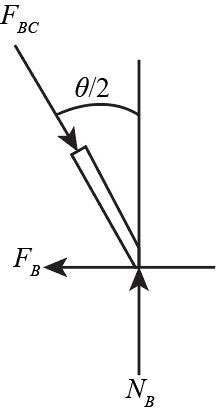
Here, ${F_B}$ is the friction force acting at support $B$, ${N_B}$ is the reaction force at $B$ and ${F_{BC}}$ is the force acting on link $BC$.
Step 4
Since the surface is slippery, any of the two supports of ladder $A$ or $B$ could slip anytime.
Let’s assume at support $B$ the slipping is occurred, then by using the friction law, the friction force acting at point $B$ is given by,
\[\begin{array}{c} {F_B} = {\mu _s}{N_B}\\ {F_B} = 0.3{N_B} \end{array}\]At equilibrium condition, balancing all the force acting on support $B$ of the ladder in the horizontal direction, we have,
\[\begin{array}{c} {F_{BC}}\sin \frac{\theta }{2} - {F_B} = 0\\ {F_{BC}}\sin \frac{\theta }{2} - 0.3{N_B} = 0\\ {F_{BC}}\sin \frac{\theta }{2} = 0.3{N_B}\\ {N_B} = 3.33{F_{BC}}\sin \frac{\theta }{2} \end{array}\]Similarly, balancing all the force acting on support $B$ of the ladder in the vertical direction, we have,
\[\begin{array}{c} {N_B} - {F_{BC}}\cos \frac{\theta }{2} = 0\\ 3.33{F_{BC}}\sin \frac{\theta }{2} = {F_{BC}}\cos \frac{\theta }{2}\\ \tan \frac{\theta }{2} = 0.3\\ \theta = 33.4^\circ \end{array}\]Step 5
Using the free-body diagram of the link $AC$, taking moments about the support $A$, we have,
\[\begin{array}{c} {F_{BC}}\sin \theta \times 2.5\;{\rm{m}} - mg \times 0.25\;{\rm{m}} = 0\\ {F_{BC}}\sin \left( {33.4^\circ } \right) \times 2.5\;{\rm{m}} - \left( {75\;{\rm{kg}} \times {\rm{9}}{\rm{.81}}\;{\rm{m/}}{{\rm{s}}^2}} \right) \times 0.25\;{\rm{m}} \times \left( {\frac{{1{\rm{ N}}}}{{{\rm{1 kg}} \cdot {\rm{m/}}{{\rm{s}}^2}}}} \right) = 0\\ {F_{BC}} = 133.66\;{\rm{N}} \end{array}\]At equilibrium condition, balancing all the forces acting on the link $AC$ in the horizontal direction, we have,
\[\begin{array}{c} {F_A} - {F_{BC}}\sin \frac{\theta }{2} = 0\\ {F_A} - 133.66\;{\rm{N}} \times \sin \frac{{33.4^\circ }}{2} = 0\\ {F_A} = 38.40\;{\rm{N}} \end{array}\]Step 6
Similarly, balancing all the forces acting on the link $AC$ in the vertical direction, we have,
\[\begin{array}{c} {N_A} + {F_{BC}}\cos \frac{\theta }{2} - mg = 0\\ {N_A} + 133.66\;{\rm{N}} \times \cos \frac{{33.4^\circ }}{2} - \left( {75\;{\rm{kg}} \times {\rm{9}}{\rm{.81}}\;{\rm{m/}}{{\rm{s}}^2}} \right) \times \left( {\frac{{1{\rm{ N}}}}{{{\rm{1 kg}} \cdot {\rm{m/}}{{\rm{s}}^2}}}} \right) = 0\\ {N_A} = 607.73\;{\rm{N}} \end{array}\]By using the friction law, the force required at point $A$ for slipping is given by,
\[\begin{array}{c} {\left( {{F_A}} \right)_{\max }} = {\mu _s}{N_A}\\ {\left( {{F_A}} \right)_{\max }} = 0.3\left( {607.73{\rm{ N}}} \right)\\ {\left( {{F_A}} \right)_{\max }} = 182.32{\rm{ N}} \end{array}\]Comparing the friction values at support $A$, we have,
\[{F_A} < {\left( {{F_A}} \right)_{\max }}\]So, the support $A$ will not slip and our assumption is correct.