
Engineering Mechanics: Statics and Dynamics, 14th Edition
Authors: Russell C. Hibbeler
ISBN-13: 978-0133915426
See our solution for Question 18P from Chapter 9 from Hibbeler's Engineering Mechanics.
Problem 18P
Step-by-Step Solution
We are given the following data:
The curve function is $y = \left[ {h - \left( {\frac{h}{{{a^n}}}} \right){x^n}} \right]$.
We are asked to locate the centroid $\bar x$ of the area.
Step 2
The free-body diagram of the curve is given below.
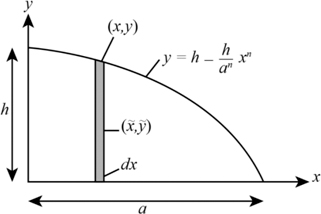
Here, consider an arbitrary element of thickness $dx$, $dA$ represent the area of the element and $\left( {\tilde x,\tilde y} \right)$ represent the coordinate of the centroid of the curve.
The area of the element can be represented as,
\[dA = ydx\]The centroid will located at distance of,
\[\begin{array}{c} \tilde x = x\\ \tilde y = \frac{y}{2} \end{array}\]Step 3
The integration limit will be ${x_1} = 0$ to ${x_2} = a$.
The formula to locate centroid $\bar x$ of the area is given by,
\[\begin{array}{c} \bar x = \frac{{\int_{\rm{A}} {\tilde xdA} }}{{\int_{\rm{A}} {dA} }}\\ = \frac{{\int_{{x_1}}^{{x_2}} {\left( {xydx} \right)} }}{{\int_{{x_1}}^{{x_2}} {\left( {ydx} \right)} }} \end{array}\]Substitute all the known values in the above formula.
\[\begin{array}{c} \bar x = \frac{{\int_0^a {\left( x \right)\left( {h - \frac{h}{{{a^n}}}{x^n}} \right)dx} }}{{\int_0^a {\left( {h - \frac{h}{{{a^n}}}{x^n}} \right)dx} }}\\ = \frac{{\int_0^a {\left( {xh - \frac{h}{{{a^n}}}{x^{\left( {n + 1} \right)}}} \right)dx} }}{{\int_0^a {\left( {h - \frac{h}{{{a^n}}}{x^n}} \right)dx} }}\\ = \frac{{\left[ {\left( {\frac{h}{2}{x^2}} \right) - \frac{{\left( h \right)\left( {{x^{\left( {n + 2} \right)}}} \right)}}{{\left( {{a^n}} \right)\left( {n + 2} \right)}}} \right]_0^a}}{{\left[ {\left( {hx} \right) - \frac{{\left( h \right)\left( {{x^{\left( {n + 1} \right)}}} \right)}}{{\left( {{a^n}} \right)\left( {n + 1} \right)}}} \right]_0^a}}\\ = \frac{{\left[ {\left( {\frac{h}{2}{a^2}} \right) - \left\{ {\frac{{\left( h \right)\left( {{a^{\left( {n + 2} \right)}}} \right)}}{{\left( {{a^n}} \right)\left( {n + 2} \right)}}} \right\} - 0 + 0} \right]}}{{\left[ {\left( {ha} \right) - \left\{ {\frac{{\left( h \right)\left( {{a^{\left( {n + 1} \right)}}} \right)}}{{\left( {{a^n}} \right)\left( {n + 1} \right)}}} \right\} - 0 + 0} \right]}} \end{array}\]On further solving the above equation,
\[\begin{array}{c} \bar x = \frac{{\left[ {\left( {\frac{1}{2}} \right) - \left\{ {\frac{{\left( 1 \right)}}{{\left( {n + 2} \right)}}} \right\}} \right]h{a^2}}}{{\left[ {1 - \left\{ {\frac{{\left( 1 \right)}}{{\left( {n + 1} \right)}}} \right\}} \right]ha}}\\ = \frac{{\left[ {\frac{{\left( {n + 2 - 2} \right)}}{{\left( 2 \right)\left( {n + 2} \right)}}} \right]a}}{{\left[ {\frac{{n + 1 - 1}}{{\left( {n + 1} \right)}}} \right]}}\\ = \frac{{\frac{{an}}{{\left( 2 \right)\left( {n + 2} \right)}}}}{{\frac{n}{{\left( {n + 1} \right)}}}}\\ = \left[ {\frac{{an}}{{\left( 2 \right)\left( {n + 2} \right)}}} \right]\left[ {\frac{{n + 1}}{n}} \right]\\ = \frac{{a\left( {n + 1} \right)}}{{2\left( {n + 2} \right)}} \end{array}\]