Engineering Mechanics: Statics and Dynamics, 14th Edition
Authors: Russell C. Hibbeler
ISBN-13: 978-0133915426
See our solution for Question 35P from Chapter 9 from Hibbeler's Engineering Mechanics.
Problem 35P
Step-by-Step Solution
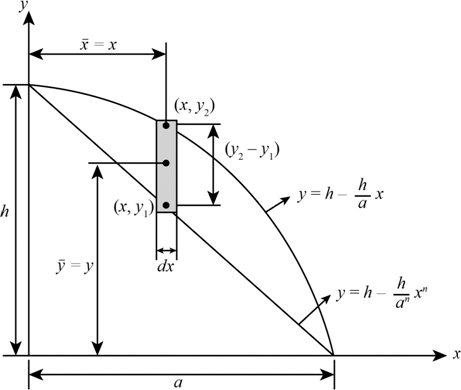
We are given that the equation of first curve is ${y_1} = h - \frac{h}{a}x$ and the equation of second curve is ${y_2} = h - \frac{h}{{{a^n}}}{x^n}$.
We are asked to locate the centroid $\bar x$ of the area.
Step 2
The centroid of the given curves is given as:
\[\left( {\bar x,\bar y} \right) = \left( {x,\frac{{{y_1} + {y_2}}}{2}} \right)\]Step 3
To calculate the area of strip we use the formula:
\[dA = \left( {{y_2} - {y_1}} \right)dx\]Step 4
Substitute the known values in the formula:
\begin{array}{c} dA = \left( {\left( {h - \frac{h}{{{a^n}}}{x^n}} \right) - \left( {h - \frac{h}{a}x} \right)} \right)dx\\ = \left( {\frac{h}{a}x - \frac{h}{{{a^n}}}{x^n}} \right)dx \end{array}Step 5
To calculate the centroid of curve about x-axis we use the formula:
\[\bar x = \frac{{\int {\bar xdA} }}{{\int {dA} }}\]...... (1)Step 6
The numerator of the equation (1) is calculated as:
\begin{array}{c} \int {\bar xdA} = \int\limits_0^a {x\left( {\frac{h}{a}x - \frac{h}{{{a^n}}}{x^n}} \right)dx} \\ = \int\limits_0^a {\left( {\frac{h}{a}{x^2} - \frac{h}{{{a^n}}}{x^{n + 1}}} \right)dx} \\ = \left[ {\frac{h}{a}\frac{{{x^3}}}{3} - \frac{h}{{{a^n}}}\frac{{{x^{n + 2}}}}{{n + 2}}} \right]_0^a \end{array}Step 7
Substitute the lower and upper limit of integration in the equation:
\[\begin{array}{c} \int {\bar x} dA = \left( {\frac{h}{a}{{\frac{{\left( a \right)}}{3}}^3} - \frac{h}{{{a^n}}}\frac{{{{\left( a \right)}^{n + 2}}}}{{n + 2}}} \right) - \left( {\frac{h}{a}{{\frac{{\left( 0 \right)}}{3}}^3} - \frac{h}{{{a^n}}}\frac{{{{\left( 0 \right)}^{n + 2}}}}{{n + 2}}} \right)\\ = \left( {\frac{{h{a^2}}}{3} - \frac{{h{a^2}}}{{n + 2}}} \right) - \left( {0 + 0} \right)\\ = h{a^2}\left( {\frac{1}{3} - \frac{1}{{n + 2}}} \right) \end{array}\]Step 8
The denominator of the equation (1) is calculated as:
\begin{array}{c} \int {dA} = \int\limits_0^2 {\left( {\frac{h}{a}x - \frac{h}{{{a^n}}}{x^n}} \right)dx} \\ = \left[ {\frac{h}{a}\frac{{{x^2}}}{2} - \frac{h}{{{a^n}}}\frac{{{x^{n + 1}}}}{{n + 1}}} \right]_0^a \end{array}Step 9
Substitute the lower and upper limit of integration in the equation:
\begin{array}{c} \int {dA} = \left( {\frac{h}{a}\frac{{{{\left( a \right)}^2}}}{2} - \frac{h}{{{a^n}}}\frac{{{{\left( a \right)}^{n + 1}}}}{{n + 1}}} \right) - \left( {\frac{h}{a}\frac{{{{\left( 0 \right)}^2}}}{2} - \frac{h}{{{a^n}}}\frac{{{{\left( 0 \right)}^{n + 1}}}}{{n + 1}}} \right)\\ = \left( {\frac{{ha}}{2} - \frac{{ha}}{{n + 1}}} \right) - \left( {0 + 0} \right)\\ = ha\left( {\frac{1}{2} - \frac{1}{{n + 1}}} \right) \end{array}Step 10
Substitute the known values in equation (1):
\begin{array}{c} \bar x = \frac{{h{a^2}\left( {\frac{1}{3} - \frac{1}{{n + 2}}} \right)}}{{ha\left( {\frac{1}{2} - \frac{1}{{n + 1}}} \right)}}\\ = \frac{{a\left( {\frac{{n + 2 - 3}}{{3\left( {n + 2} \right)}}} \right)}}{{\left( {\frac{{n + 1 - 2}}{{2\left( {n + 1} \right)}}} \right)}}\\ = \frac{{a\left( {\frac{{n - 1}}{{3\left( {n + 2} \right)}}} \right)}}{{\left( {\frac{{n - 1}}{{2\left( {n + 1} \right)}}} \right)}}\\ = \left( {\frac{{2\left( {n + 1} \right)}}{{3\left( {n + 2} \right)}}} \right)a \end{array}