Engineering Mechanics: Statics and Dynamics, 14th Edition
Authors: Russell C. Hibbeler
ISBN-13: 978-0133915426
See our solution for Question 61P from Chapter 9 from Hibbeler's Engineering Mechanics.
Problem 61P
Step-by-Step Solution
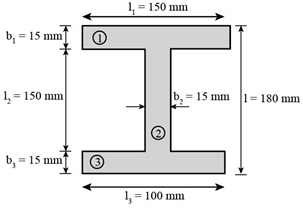
We are required to find the $\overline y $ of the centroid C of the beam.
Step 2
The diagram can be represented as below:
Step 3
To locate the centroid $\overline y $ we will use the relation,
\[\overline y = \frac{{{a_1}{y_1} + {a_2}{y_2} + {a_3}{y_3}}}{{{a_1} + {a_2} + {a_3}}}\]….. (1)Here, ${a_1}$ represents the area of the rectangle 1, ${a_2}$ represents the area of the rectangle 2,${a_3}$ represents the area of the rectangle 3, ${y_1}$ represents the distance of center of gravity of rectangle 1 from the top, ${y_2}$ represents the distance of center of gravity of rectangle 2 from the bottom and ${y_3}$ represents the distance of center of gravity of rectangle 3 from the bottom.
Step 4
To find the center of gravity of rectangle 1, we will use the relation,
\[\begin{array}{c} {y_1} = \frac{{{b_1}}}{2}\\ = \frac{{15\;{\rm{mm}}}}{2}\\ = {\rm{7}}{\rm{.5 mm}} \end{array}\]Step 5
To find the center of gravity of rectangle 2, we will use the relation,
\[\begin{array}{c} {y_2} = {b_1} + \frac{{{l_2}}}{2}\\ = 15{\rm{ mm}} + \frac{{150\;{\rm{mm}}}}{2}\\ = 15{\rm{ mm}} + 75\,{\rm{mm}}\\ = {\rm{90 mm}} \end{array}\]Step 6
To find the center of gravity of rectangle 3, we will use the relation,
\[\begin{array}{c} {y_3} = {b_1} + {l_2} + \frac{{{b_3}}}{2}\\ = 15{\rm{ mm}} + 150{\rm{ mm}} + \frac{{15{\rm{ mm}}}}{2}\\ = 15{\rm{ mm}} + 150{\rm{ mm}} + 7.5{\rm{ mm}}\\ = 172.5{\rm{ mm}} \end{array}\]Step 7
To find the area of rectangle 1, we will use the relation.
\[{a_1} = {l_1} \times {b_1}\]Here, ${l_1}$ and ${b_1}$ represents the length and breadth of the rectangle 1.
Step 8
On plugging the values in the above relation, we get,
\[\begin{array}{c} {a_1} = 150{\rm{ mm}} \times 15{\rm{ mm}}\\ = {\rm{2250}}\;{\rm{m}}{{\rm{m}}^2} \end{array}\]Step 9
To find the area of rectangle 2, we will use the relation.
\[{a_2} = {l_2} \times {b_2}\]Here, ${l_2}$ and ${b_2}$ represents the length and breadth of the rectangle 2.
Step 10
On plugging the values in the above relation, we get,
\[\begin{array}{c} {a_2} = 150{\rm{ mm}} \times 15{\rm{ mm}}\\ = {\rm{2250}}\;{\rm{m}}{{\rm{m}}^2} \end{array}\]Step 11
To find the area of rectangle 3, we will use the relation.
\[{a_3} = {l_3} \times {b_3}\]Here, ${l_3}$ and ${b_3}$ represents the length and breadth of the rectangle 3.
Step 12
On plugging the values in the above relation, we get,
\[\begin{array}{c} {a_3} = 100{\rm{ mm}} \times 15{\rm{ mm}}\\ = {\rm{1500}}\;{\rm{m}}{{\rm{m}}^2} \end{array}\]Step 13
On plugging the values in the equation (1), we get,
\[\begin{array}{c} \overline y = \frac{{\left( {2250{\rm{ m}}{{\rm{m}}^2} \times 7.5{\rm{ mm}}} \right) + \left( {2250\,{\rm{m}}{{\rm{m}}^2} \times 90{\rm{ mm}}} \right) + \left( {1500\,{\rm{m}}{{\rm{m}}^2} \times 172.5{\rm{ mm}}} \right)}}{{2250{\rm{ m}}{{\rm{m}}^2} + 2250{\rm{ m}}{{\rm{m}}^2} + 1500{\rm{ m}}{{\rm{m}}^2}}}\\ = \frac{{16875{\rm{ m}}{{\rm{m}}^3} + 202500{\rm{ m}}{{\rm{m}}^3} + 258750{\rm{ m}}{{\rm{m}}^3}}}{{6000\,{\rm{m}}{{\rm{m}}^2}}}\\ = \frac{{{\rm{478125 m}}{{\rm{m}}^3}}}{{100800\,{\rm{m}}{{\rm{m}}^2}}}\\ = 79.687{\rm{ mm}} \end{array}\]