Engineering Mechanics: Statics and Dynamics, 14th Edition
Authors: Russell C. Hibbeler
ISBN-13: 978-0133915426
See our solution for Question 64P from Chapter 9 from Hibbeler's Engineering Mechanics.
Problem 64P
Step-by-Step Solution
We are required to locate the centroid $\left( {\overline x ,\overline y } \right)$ of the shaded area.
Step 2
The diagram can be represented as below:
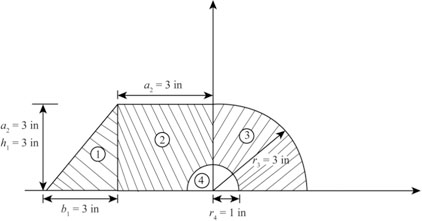
Here, ${b_1}{\rm{ \;and\; }}{h_1}$ represents the base and height of triangle 1, ${a_2}$ represents the side of the square 2, ${r_3}$ represents the radius of circle 3 and ${r_4}$ represents the radius of circle 4.
Step 3
To locate the centroid $\overline x $ we will use the relation,
\[\overline x = \frac{{{A_1}{x_1} + {A_2}{x_2} + {A_3}{x_3} - {A_4}{x_4}}}{{{A_1} + {A_2} + {A_3} - {A_4}}}\] ….. (1)Here, ${A_1}$ represents the area of the region 1, ${A_2}$ represents the area of the region 2, ${A_3}$ represents the area of the region 3, ${A_4}$ represents the area of the region 4, ${x_1}$ represents the distance of center of gravity of region 1 from the origin, ${x_2}$ represents the distance of center of gravity of region 2 from the origin, ${x_3}$ represents the distance of center of gravity of region 3 from the origin and ${x_4}$ represents the distance of center of gravity of region 4 from the origin.
Step 4
To find the center of gravity in horizontal axis of region 1 which is a triangle, we will use the relation,
\[\begin{array}{c} {x_1} = {a_2} + \frac{{{b_1}}}{3}\\ = - 3\;{\rm{in}}{\rm{.}} - \frac{{3\,{\rm{in}}{\rm{.}}}}{3}\\ = - 3{\rm{ in}}{\rm{.}} - {\rm{1}}\,{\rm{in}}{\rm{.}}\\ = - 4{\rm{ in}}{\rm{.}} \end{array}\]Step 5
To find the center of gravity in horizontal axis of region 2 which is a square, we will use the relation,
\[\begin{array}{c} {x_2} = \frac{{{a_2}}}{2}\\ = \frac{{ - 3\;{\rm{in}}{\rm{.}}}}{2}\\ = - 1.5{\rm{ in}}{\rm{.}} \end{array}\]Step 6
To find the center of gravity in horizontal axis of region 3 which is a circle, we will use the relation,
\[\begin{array}{c} {x_3} = \frac{{4{r_3}}}{{3\pi }}\\ = \frac{{4 \times 3{\rm{ in}}{\rm{.}}}}{{3\pi }}\\ = 1.273{\rm{ in}}{\rm{.}} \end{array}\]Step 6
To find the center of gravity in horizontal axis of region 4 which is a circle, we will use the relation,
\[\begin{array}{c} {x_4} = \frac{{4{r_4}}}{{3\pi }} - \frac{{4{r_4}}}{{3\pi }}\\ = \frac{{4 \times 1{\rm{ in}}{\rm{.}}}}{{3\pi }} - \frac{{4 \times 1{\rm{ in}}{\rm{.}}}}{{3\pi }}\\ = 0.424{\rm{ in}}{\rm{.}} - 0.424{\rm{ in}}{\rm{.}}\\ = 0{\rm{ in}}{\rm{.}} \end{array}\]Step 7
To locate the centroid $\overline y $ we will use the relation,
\[\overline y = \frac{{{A_1}{y_1} + {A_2}{y_2} + {A_3}{y_3} - {A_4}{y_4}}}{{{A_1} + {A_2} + {A_3} - {A_4}}}\] ….. (2)Here, ${A_1}$ represents the area of the region 1, ${A_2}$ represents the area of the region 2, ${A_3}$ represents the area of the region 3, ${y_1}$ represents the distance of center of gravity of region 1 from the origin, ${y_2}$ represents the distance of center of gravity of region 2 from the origin, ${y_3}$ represents the distance of center of gravity of region 3 from the origin and ${y_4}$ represents the distance of center of gravity of region 4 from the origin.
Step 8
To find the center of gravity in vertical axis of region 1 which is a triangle, we will use the relation,
\[\begin{array}{c} {y_1} = \frac{{{h_1}}}{3}\\ = \frac{{3{\rm{ in}}{\rm{.}}}}{3}\\ = 1{\rm{ in}}{\rm{.}} \end{array}\]Step 9
To find the center of gravity in vertical axis of region 2 which is a square, we will use the relation,
\[\begin{array}{c} {y_2} = \frac{{{a_2}}}{2}\\ = \frac{{3{\rm{ in}}{\rm{.}}}}{2}\\ = {\rm{1}}{\rm{.5 in}}{\rm{.}} \end{array}\]Step 10
To find the center of gravity in vertical axis of region 3 which is a circle, we will use the relation,
\[\begin{array}{c} {y_3} = \frac{{4{r_3}}}{{3\pi }}\\ = \frac{{4 \times 3{\rm{ in}}{\rm{.}}}}{{3\pi }}\\ = 1.273{\rm{ in}}{\rm{.}} \end{array}\]Step 10
To find the center of gravity in vertical axis of region 4 which is a circle, we will use the relation,
\[\begin{array}{c} {y_4} = \frac{{4{r_4}}}{{3\pi }}\\ = \frac{{4 \times 1{\rm{ in}}{\rm{.}}}}{{3\pi }}\\ = 0.424{\rm{ in}}{\rm{.}} \end{array}\]Step 11
To find the area of region 1 which is a triangle, we will use the relation.
\[{A_1} = \frac{1}{2} \times {b_1} \times {h_1}\]Here, ${b_1}{\rm{ \;and\; }}{h_1}$ represents the breadth and heightof the triangle 1.
Step 12
On plugging the values in the above relation, we get,
\[\begin{array}{c} {A_1} = \frac{1}{2} \times 3{\rm{ in}}{\rm{.}} \times 3{\rm{ in}}{\rm{.}}\\ = 4.5\;{\rm{in}}{{\rm{.}}^2} \end{array}\]Step 13
To find the area of region 2 which is a square, we will use the relation.
\[{A_2} = {a_2} \times {a_2}\]Here, ${a_2}$ represents the sides of the square 2.
Step 14
On plugging the values in the above relation, we get,
\[\begin{array}{c} {A_2} = {\rm{3}}\;{\rm{in}}{\rm{.}} \times {\rm{3}}\;{\rm{in}}{\rm{.}}\\ = 9\;{\rm{in}}{{\rm{.}}^2} \end{array}\]Step 15
To find the area of region 3 which is a circle, we will use the relation.
\[{A_3} = \frac{{\pi r_3^2}}{4}\]Here, ${r_3}$ represents the radius of the circle 3.
Step 16
On plugging the values in the above relation, we get,
\[\begin{array}{c} {A_3} = \frac{{\pi {{\left( {3{\rm{ in}}{\rm{.}}} \right)}^2}}}{4}\\ = 7.068{\rm{ in}}{{\rm{.}}^2} \end{array}\]Step 15
To find the area of region 4 which is a circle, we will use the relation.
\[{A_4} = \frac{{\pi r_4^2}}{2}\]Here, ${r_4}$ represents the radius of the circle 4.
Step 16
On plugging the values in the above relation, we get,
\[\begin{array}{c} {A_4} = \frac{{\pi {{\left( {1{\rm{ in}}{\rm{.}}} \right)}^2}}}{2}\\ = 1.571{\rm{ in}}{{\rm{.}}^2} \end{array}\]Step 17
On plugging the values in the equation (1), we get,
\[\begin{array}{c} \overline x = \frac{{\left( {4.5{\rm{ in}}{{\rm{.}}^2} \times \left( { - 4\;{\rm{in}}{\rm{.}}} \right)} \right) + \left( {9{\rm{ in}}{{\rm{.}}^2} \times \left( { - 1.5{\rm{ in}}{\rm{.}}} \right)} \right) + \left( {7.068{\rm{ in}}{{\rm{.}}^2} \times 1.273{\rm{ in}}{\rm{.}}} \right) - \left( {1.571{\rm{ in}}{{\rm{.}}^2} \times 0{\rm{ in}}{\rm{.}}} \right)}}{{4.5{\rm{ in}}{{\rm{.}}^2} + 9{\rm{ in}}{{\rm{.}}^2} + 7.068{\rm{ in}}{{\rm{.}}^2} - 1.571{\rm{ in}}{{\rm{.}}^2}}}\\ = \frac{{ - {\rm{18 in}}{{\rm{.}}^3} - 13.5{\rm{ in}}{{\rm{.}}^3} + 8.997{\rm{ in}}{{\rm{.}}^3} - 0{\rm{ in}}{{\rm{.}}^3}}}{{18.997{\rm{ in}}{{\rm{.}}^2}}}\\ = \frac{{ - {\rm{22}}{\rm{.503 in}}{{\rm{.}}^3}}}{{18.997{\rm{ in}}{{\rm{.}}^2}}}\\ = - 1.184{\rm{ in}}{\rm{.}} \end{array}\]Step 18
On plugging the values in the equation (2), we get,
\[\begin{array}{c} \overline y = \frac{{\left( {4.5{\rm{ in}}{{\rm{.}}^2} \times 1\;{\rm{in}}{\rm{.}}} \right) + \left( {9{\rm{ in}}{{\rm{.}}^2} \times 1.5{\rm{ in}}{\rm{.}}} \right) + \left( {7.068{\rm{ in}}{{\rm{.}}^2} \times 1.273{\rm{ in}}{\rm{.}}} \right) - \left( {1.571{\rm{ in}}{{\rm{.}}^2} \times 0.424{\rm{ in}}{\rm{.}}} \right)}}{{4.5{\rm{ in}}{{\rm{.}}^2} + 9{\rm{ in}}{{\rm{.}}^2} + 7.068{\rm{ in}}{{\rm{.}}^2} - 1.571{\rm{ in}}{{\rm{.}}^2}}}\\ = \frac{{{\rm{4}}{\rm{.5 in}}{{\rm{.}}^3} + 13.5{\rm{ in}}{{\rm{.}}^3} + 8.997{\rm{ in}}{{\rm{.}}^3} - 0.666{\rm{ in}}{{\rm{.}}^3}}}{{18.997{\rm{ in}}{{\rm{.}}^2}}}\\ = \frac{{{\rm{26}}{\rm{.331 in}}{{\rm{.}}^3}}}{{18.997{\rm{ in}}{{\rm{.}}^2}}}\\ = 1.386{\rm{ in}}{\rm{.}} \end{array}\]