Engineering Mechanics: Statics and Dynamics, 14th Edition
Authors: Russell C. Hibbeler
ISBN-13: 978-0133915426
See our solution for Question 81P from Chapter 9 from Hibbeler's Engineering Mechanics.
Problem 81P
Step-by-Step Solution
We are given an assembly consisting of a steel hemisphere and an aluminum cylinder.
The following data is given:
The density of the steel hemisphere is ${\rho _{st}} = 7.80{\rm{ Mg/}}{{\rm{m}}^3}$.
The density of the aluminum cylinder is ${\rho _{al}} = 2.70{\rm{ Mg/}}{{\rm{m}}^3}$.
The height of the cylinder is $h = 200{\rm{ mm}}$.
We are required to determine the mass center of the assembly.
Step 2
The diagrammatic representation of the assembly showing both the sections is given below:
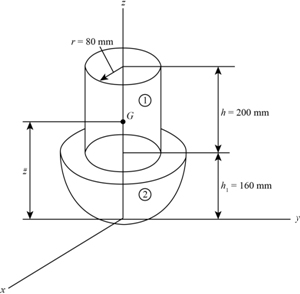
Here, $G$ represents the center of mass of the assembly and $\overline z $ is the distance of center of mass along the $z$ axis.
Step 3
The distance of the center of mass of the top aluminum cylinder section 1 along the $z$ axis is given by,
\[\begin{array}{l} {z_1} = {h_1} + \frac{h}{2}\\ {z_1} = 160{\rm{ mm}} + \left( {\frac{{200{\rm{ mm}}}}{2}} \right)\\ {z_1} = 260{\rm{ mm}} \times \left( {\frac{{1{\rm{ m}}}}{{1000{\rm{ mm}}}}} \right)\\ {z_1} = 0.26{\rm{ m}} \end{array}\]The distance of the center of mass of the bottomsteel hemisphere section 2 along the $z$ axis is given by,
\[\begin{array}{c} {z_2} = {h_1} - \frac{3}{8}{h_1}\\ {z_2} = {\rm{160 mm}} - \left( {\frac{3}{8} \times {\rm{160}}} \right){\rm{ mm}}\\ {z_2} = 100{\rm{ mm}} \times \left( {\frac{{1{\rm{ m}}}}{{1000{\rm{ mm}}}}} \right)\\ {z_2} = 0.1{\rm{ m}} \end{array}\]Step 4
The expression for the mass of the bottom steel hemisphere section 2 is given by,
\[\begin{array}{l} {m_2} = {\rho _{st}} \times {V_2}\\ {m_2} = {\rho _{st}} \times \frac{{2\pi }}{3}{\left( {{h_1}} \right)^3}\\ {m_2} = \left( {7.80{\rm{ Mg/}}{{\rm{m}}^3} \times \frac{{1000{\rm{ kg/}}{{\rm{m}}^3}}}{{1{\rm{ Mg/}}{{\rm{m}}^3}}}} \right) \times \left( {\frac{{2\pi }}{3} \times {{\left( {{\rm{160 mm}} \times \frac{{1{\rm{ m}}}}{{1000{\rm{ mm}}}}} \right)}^3}} \right)\\ {m_2} = 66.91{\rm{ kg}} \end{array}\]The expression for the mass of the top aluminum cylinder section 1 is given by,
\[\begin{array}{l} {m_1} = {\rho _{al}} \times {V_1}\\ {m_1} = {\rho _{al}} \times \left( {\pi {r^2}h} \right)\\ {m_1} = \left( {2.70{\rm{ Mg/}}{{\rm{m}}^3} \times \frac{{1000{\rm{ kg/}}{{\rm{m}}^3}}}{{1{\rm{ Mg/}}{{\rm{m}}^3}}}} \right) \times \left[ {\pi \times {{\left( {{\rm{80 mm}} \times \frac{{1{\rm{ m}}}}{{1000{\rm{ mm}}}}} \right)}^2} \times \left( {200{\rm{ mm}} \times \frac{{1{\rm{ m}}}}{{1000{\rm{ mm}}}}} \right)} \right]\\ {m_1} = 10.857{\rm{ kg}} \end{array}\]Then, the total mass of the assembly is given by,
\[\begin{array}{l} \sum m = {m_1} + {m_2}\\ \sum m = 10.857{\rm{ kg}} + 66.91{\rm{ kg}}\\ \sum m = 77.767{\rm{ kg}} \end{array}\]Step 5
Now using the formula for the center of mass, the center of mass of the assembly is given by,
\[\begin{array}{l} \overline z = \frac{{\sum {mz} }}{{\sum m }}\\ \overline z = \frac{{{m_1}{z_1} + {m_2}{z_2}}}{{\sum m }} \end{array}\]On substituting the values in the above expression, we get,
\[\begin{array}{l} \overline z = \frac{{\left( {10.857{\rm{ kg}} \times {\rm{0}}{\rm{.26 m}}} \right) + \left( {66.91{\rm{ kg}} \times {\rm{0}}{\rm{.1 m}}} \right)}}{{\left( {77.767{\rm{ kg}}} \right)}}\\ \overline z = \frac{{\left( {9.514{\rm{ kg}} \cdot {\rm{m}}} \right)}}{{\left( {77.767{\rm{ kg}}} \right)}}\\ \overline z = \left( {0.122{\rm{ m}} \times \frac{{1000{\rm{ mm}}}}{{1{\rm{ m}}}}} \right)\\ \overline z = 122{\rm{ mm}} \end{array}\]