Engineering Mechanics: Statics and Dynamics, 14th Edition
Authors: Russell C. Hibbeler
ISBN-13: 978-0133915426
See our solution for Question 89P from Chapter 9 from Hibbeler's Engineering Mechanics.
Problem 89P
Step-by-Step Solution
We are given the density of steel segment is ${\rho _{st}} = 7.85\;{\rm{Mg/}}{{\rm{m}}^3}$ and the density of brass segment is ${\rho _{br}} = 8.74\;{\rm{Mg/}}{{\rm{m}}^3}$.
We are asked to determine the mass and location $\left( {\bar x,\bar y,\bar z} \right)$ of its mass center G.
Step 2
The diagram of the system is shown as:
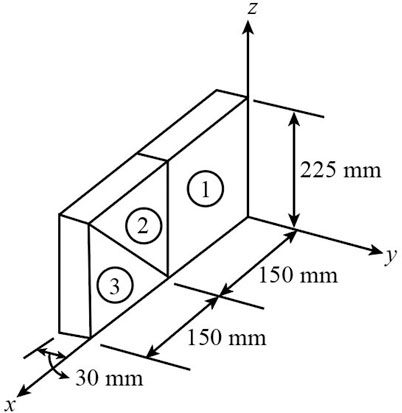
We have the length of rectangular part 1 is ${l_1} = 150\;{\rm{mm}}$.
We have the base of triangular part 2 is ${l_2} = 150\;{\rm{mm}}$.
We have the base of triangular part 3 is ${l_3} = 150\;{\rm{mm}}$.
We have the height of the assembly is $h = 225\;{\rm{mm}}$.
We have the thickness of the assembly is $t = 30\;{\rm{mm}}$.
Step 3
The formula to calculate the mass of part 1 is,
\[{m_1} = {\rho _{st}}\left( {{l_1} \times h \times t} \right)\]Step 4
Substitute the values in the above expression.
\[\begin{array}{l} {m_1} = 7.85\;{\rm{Mg/}}{{\rm{m}}^3}\left( {150\;{\rm{mm}} \times 225\;{\rm{mm}} \times 30\;{\rm{mm}} \times \frac{{{{10}^{ - 9}}\;{{\rm{m}}^3}}}{{1\;{\rm{m}}{{\rm{m}}^3}}}} \right)\\ {m_1} = 7.95 \times {10^{ - 3}}\;{\rm{Mg}} \end{array}\]Step 5
The formula to calculate the centroid of the part 1 along x-axis is,
\[{\bar x_1} = \frac{{{l_1}}}{2}\]Step 6
Substitute the values in the above expression.
\[\begin{array}{l} {{\bar x}_1} = \frac{{150\;{\rm{mm}}}}{2}\\ {{\bar x}_1} = 75\;{\rm{mm}} \end{array}\]Step 7
The formula to calculate the centroid of the part 1 along z-axis is,
\[{\bar z_1} = \frac{h}{2}\]Step 8
Substitute the values in the above expression.
\[\begin{array}{l} {{\bar z}_1} = \frac{{225\;{\rm{mm}}}}{2}\\ {{\bar z}_1} = 112.5\;{\rm{mm}} \end{array}\]Step 9
The formula to calculate the mass of part 2 is,
\[{m_2} = {\rho _{st}}\left( {\frac{1}{2} \times {l_2} \times h \times t} \right)\]Step 10
Substitute the values in the above expression.
\[\begin{array}{l} {m_2} = 7.85\;{\rm{Mg/}}{{\rm{m}}^3}\left( {\frac{1}{2} \times 150\;{\rm{mm}} \times 225\;{\rm{mm}} \times 30\;{\rm{mm}} \times \frac{{{{10}^{ - 9}}\;{{\rm{m}}^3}}}{{1\;{\rm{m}}{{\rm{m}}^3}}}} \right)\\ {m_2} = 3.975 \times {10^{ - 3}}\;{\rm{Mg}} \end{array}\]Step 11
The formula to calculate the centroid of the part 2 along x-axis is,
\[{\bar x_2} = {l_1} + \frac{{{l_2}}}{3}\]Step 12
Substitute the values in the above expression.
\[\begin{array}{l} {{\bar x}_2} = 150\;{\rm{mm}} + \frac{{150\;{\rm{mm}}}}{3}\\ {{\bar x}_2} = 200\;{\rm{mm}} \end{array}\]Step 13
The formula to calculate the centroid of the part 2 along z-axis is,
\[{\bar z_2} = \frac{2}{3}h\]Step 14
Substitute the values in the above expression.
\[\begin{array}{l} {{\bar z}_2} = \frac{2}{3}\left( {225\;{\rm{mm}}} \right)\\ {{\bar z}_2} = 150\;{\rm{mm}} \end{array}\]Step 15
The formula to calculate the mass of part 3 is,
\[{m_3} = {\rho _{br}}\left( {\frac{1}{2} \times {l_3} \times h \times t} \right)\]Step 16
Substitute the values in the above expression.
\[\begin{array}{l} {m_3} = 8.74\;{\rm{Mg/}}{{\rm{m}}^3}\left( {\frac{1}{2} \times 150\;{\rm{mm}} \times 225\;{\rm{mm}} \times 30\;{\rm{mm}} \times \frac{{{{10}^{ - 9}}\;{{\rm{m}}^3}}}{{1\;{\rm{m}}{{\rm{m}}^3}}}} \right)\\ {m_3} = 4.425 \times {10^{ - 3}}\;{\rm{Mg}} \end{array}\]Step 17
The formula to calculate the centroid of the part 3 along x-axis is,
\[{\bar x_3} = {l_1} + \frac{2}{3}{l_3}\]Step 18
Substitute the values in the above expression.
\[\begin{array}{l} {{\bar x}_3} = 150\;{\rm{mm}} + \frac{2}{3}\left( {150\;{\rm{mm}}} \right)\\ {{\bar x}_3} = 250\;{\rm{mm}} \end{array}\]Step 19
The formula to calculate the centroid of the part 3 along z-axis is,
\[{\bar z_3} = \frac{1}{3}h\]Step 20
Substitute the values in the above expression.
\[\begin{array}{l} {{\bar z}_3} = \frac{1}{3}\left( {225\;{\rm{mm}}} \right)\\ {{\bar z}_3} = 75\;{\rm{mm}} \end{array}\]Step 21
The formula to calculate the mass of the composite pate is,
\[m = {m_1} + {m_2} + {m_3}\]Step 22
Substitute the values in the above expression.
\[\begin{array}{l} m = 7.95 \times {10^{ - 3}}\;{\rm{Mg}} + 3.975 \times {10^{ - 3}}\;{\rm{Mg}} + 4.425 \times {10^{ - 3}}\;{\rm{Mg}}\\ m = 16.35 \times {10^{ - 3}}\;{\rm{Mg}} \end{array}\]Step 23
The formula to calculate the center of mass of the composite pate about x-axis is,
\[\bar x = \frac{{{m_1}{{\bar x}_1} + {m_2}{{\bar x}_2} + {m_3}{{\bar x}_3}}}{m}\]Step 24
Substitute the values in the above expression.
\[\begin{array}{l} \bar x = \frac{{\left[ \begin{array}{l} \left( {7.95 \times {{10}^{ - 3}}\;{\rm{Mg}}} \right)\left( {75\;{\rm{mm}}} \right) + \left( {3.975 \times {{10}^{ - 3}}\;{\rm{Mg}}} \right)\left( {200\;{\rm{mm}}} \right)\\ + \left( {4.425 \times {{10}^{ - 3}}\;{\rm{Mg}}} \right)\left( {250\;{\rm{mm}}} \right) \end{array} \right]}}{{16.35 \times {{10}^{ - 3}}\;{\rm{Mg}}}}\\ \bar x = 152.8\;{\rm{mm}} \end{array}\]Step 25
The composite plate is symmetric in y-axis, therefore the center of mass of each element is equal.
The formula to calculate the center of mass of the composite pate about y-axis is,
\[\bar y = - \frac{t}{2}\]Step 26
Substitute the values in the above expression.
\[\begin{array}{l} \bar y = - \frac{{30\;{\rm{mm}}}}{2}\\ \bar y = - 15\;{\rm{mm}} \end{array}\]Step 27
The formula to calculate the center of mass of the composite pate about z-axis is,
\[\bar z = \frac{{{m_1}{{\bar z}_1} + {m_2}{{\bar z}_2} + {m_3}{{\bar z}_3}}}{m}\]Step 28
Substitute the values in the above expression.
\[\begin{array}{l} \bar z = \frac{{\left[ \begin{array}{l} \left( {7.95 \times {{10}^{ - 3}}\;{\rm{Mg}}} \right)\left( {112.5\;{\rm{mm}}} \right) + \left( {3.975 \times {{10}^{ - 3}}\;{\rm{Mg}}} \right)\left( {150\;{\rm{mm}}} \right)\\ + \left( {4.425 \times {{10}^{ - 3}}\;{\rm{Mg}}} \right)\left( {75\;{\rm{mm}}} \right) \end{array} \right]}}{{16.35 \times {{10}^{ - 3}}\;{\rm{Mg}}}}\\ \bar z = 111.4\;{\rm{mm}} \end{array}\]