Engineering Mechanics: Statics and Dynamics, 14th Edition
Authors: Russell C. Hibbeler
ISBN-13: 978-0133915426
See our solution for Question 9P from Chapter 9 from Hibbeler's Engineering Mechanics.
Problem 9P
Step-by-Step Solution
We are given the width and height of a shaded portion as $4\;{\rm{m}}$ and the curve equation as $y = \frac{1}{4}{x^2}$.
We are asked to locate the centroid $\bar x$ of the shaded area.
Step 2
We can consider a differential element inside the parabolic area which can be represented as:
s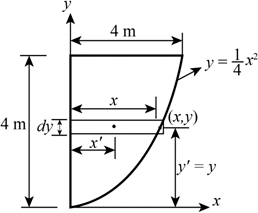
Here, $dy$ is the width of the differential element, $x'$ is the x coordinate of the centroid of the elemental area, $y'$ is the y co-ordinate of the centroid of the elemental area and x is the length of a differential element.
The curve equation is given as:
\begin{array}{c} y = \frac{1}{4}{x^2}\\ x = \sqrt {4y} \\ x = 2\sqrt y \end{array}To calculate the x-centroid of the parabolic area, we have:
\[\bar x = \frac{{\int\limits_A {x'dA} }}{{\int\limits_A {dA} }}\] …. (1)The area of the differential element $\left( {dA} \right)$ can be given as:
\[dA = xdy\]Substitute the values in the above expression, we get:
\[dA = \left( {2\sqrt y } \right)dy\] …. (2)Now, to calculate the centroid of the elemental area located about the x-axis, we have:
\[x' = \frac{x}{2}\]Substitute the value of x in the above expression, we get:
\begin{array}{c} x' = \frac{{2\sqrt y }}{2}\\ x' = \sqrt y \end{array}Step 3
To calculate the integral of $dA$, we need to integrate equation (2) from limit $0$ to $4\;{\rm{m}}$ as:
\[\begin{array}{c} \int\limits_A {dA} = \int\limits_0^{4\;{\rm{m}}} {\left( {2\sqrt y } \right)dy} \\ \int\limits_A {dA} = 2\left[ {\left( {\frac{2}{3}{y^{{3 \mathord{\left/ {\vphantom {3 2}} \right. } 2}}}} \right)} \right]_0^{4\;{\rm{m}}}\\ \int\limits_A {dA} = \left( {\frac{4}{3}} \right)\left( {{y^{{3 \mathord{\left/ {\vphantom {3 2}} \right. } 2}}}} \right)_0^{4\;{\rm{m}}} \end{array}\]Substitute the limit in y, we get:
\[\begin{array}{c} \int\limits_A {dA} = \left( {\frac{4}{3}} \right) \times \left[ {{{\left( 4 \right)}^{{3 \mathord{\left/ {\vphantom {3 2}} \right. } 2}}} - 0} \right]\\ \int\limits_A {dA} = \left( {\frac{4}{3}} \right) \times 8\\ \int\limits_A {dA} = \frac{{32}}{3} \end{array}\]Substitute the values in equation (1), we get:
\begin{array}{c} \bar x = \frac{{\int\limits_0^{4\;{\rm{m}}} {\left( {\sqrt y } \right)\left( {2\sqrt y } \right)dy} }}{{\left( {\frac{{32}}{3}} \right)}}\\ \bar x = \frac{{\int\limits_0^{4\;{\rm{m}}} {2ydy} }}{{\left( {\frac{{32}}{3}} \right)}}\\ \bar x = \left( {\frac{3}{{16}}} \right) \times \left( {\frac{{{y^2}}}{2}} \right)_0^{4\;{\rm{m}}} \end{array}Substitute the limit in y, we get:
\begin{array}{c} \bar x = \left( {\frac{3}{{16}}} \right) \times \left[ {\frac{{{{\left( {4\;{\rm{m}}} \right)}^2}}}{2} - \frac{{{{\left( 0 \right)}^2}}}{2}} \right]\\ \bar x = \left( {\frac{3}{{16}}} \right) \times \left( 8 \right)\;{\rm{m}}\\ \bar x = \frac{3}{2}\;{\rm{m}} \end{array}