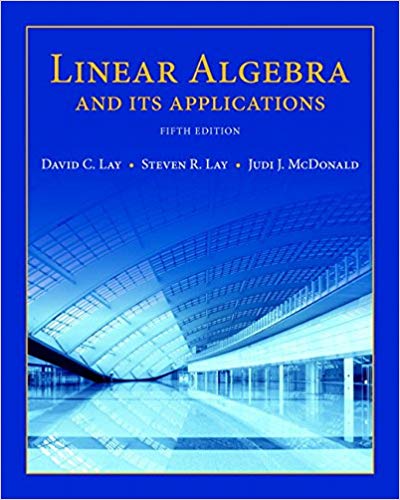
Linear Algebra and Its Applications, 5th Edition
Authors: David C. Lay, Steven R. Lay, Judi J. McDonald
ISBN-13: 978-0321982384
We have solutions for your book!
See our solution for Question 11E from Chapter 1.3 from Lay's Linear Algebra and Its Applications, 5th Edition.
Problem 11E
Chapter:
Problem:
0
Step-by-Step Solution
Step 1
Given Vectors:
\[\mathbf{a}_{1}=\left[\begin{array}{r}1 \\-2 \\2\end{array}\right], \mathbf{a}_{2}=\left[\begin{array}{l}0 \\5 \\5\end{array}\right], \mathbf{a}_{3}=\left[\begin{array}{l}2 \\0 \\8\end{array}\right], \mathbf{b}=\left[\begin{array}{r}-5 \\11 \\-7\end{array}\right]\]We have to find whether the vector ${\bf{b}}$ is a linear combination of given vectors $\left( {{{\bf{a}}_1},\,{{\bf{a}}_2},\,{{\bf{a}}_3}} \right)$.
To find the same we will find the solution of the set of equations: \[{x_1}{{\bf{a}}_{\bf{1}}} + {x_2}{{\bf{a}}_{\bf{2}}} + {x_3}{{\bf{a}}_{\bf{3}}} = {\bf{b}}\]If we are able to find real values of these coefficients, then vector $b$ is a linear combination of given vectors
Step 2: Write the system of Equations
\[\begin{array}{l}{x_1}{{\bf{a}}_{\bf{1}}} + {x_2}{{\bf{a}}_{\bf{2}}} + {x_3}{{\bf{a}}_{\bf{3}}} = {\bf{b}}\\\\{x_1}\left[ {\begin{array}{*{20}{r}}1\\{ - 2}\\0\end{array}} \right] + {x_2}\left[ {\begin{array}{*{20}{l}}0\\1\\2\end{array}} \right] + {x_3}\left[ {\begin{array}{*{20}{c}}5\\{ - 6}\\8\end{array}} \right] = \left[ {\begin{array}{*{20}{c}}2\\{ - 1}\\6\end{array}} \right]\end{array}\]
Step 2: The augmented form
We can convert above system of equations into an Augmented matrix form
\[A = \left[ {\begin{array}{*{20}{r}}1&0&5&2\\{ - 2}&1&{ - 6}&{ - 1}\\0&2&8&6\end{array}} \right]\]
Step 3: Convert to Echelon Form
We will convert the Augmented matrix into Echelon form by row-reducing it
\[\begin{array}{l}A = \left[ {\begin{array}{*{20}{r}}1&0&5&2\\{ - 2}&1&{ - 6}&{ - 1}\\0&2&8&6\end{array}} \right]\\\\ = \left[ {\begin{array}{*{20}{r}}1&0&5&2\\0&1&4&3\\0&2&8&6\end{array}} \right]::{\kern 1pt} {R_2} = {R_1} + 2{R_1}\\\\ = \left[ {\begin{array}{*{20}{r}}1&0&5&2\\0&1&4&3\\0&0&0&0\end{array}} \right]:{\kern 1pt} :{R_3} = {R_3} - 2{R_2}{\kern 1pt} {\kern 1pt} \end{array}\]
Step 4: System of Equations
Re-convert to system of equations
\[\begin{array}{l}{x_1} = 2 - 5{x_3}\\\\{x_2} = 3 - 4{x_3}\\\\{x_3} = t\end{array}\]Since, the last row has all zero elements, we have assumed t as a parametric constant for $x_3$
In this case, there are infinite possible solutions. For example, by choosing any $t$ value, we can have multiple values of x$_1$ and x$_2$
ANSWERS
Since a solution exists for the given system of equations, Therefore,
${\bf{b}}$ is a linear combination of given vectors $\left( {{{\bf{a}}_1},\,{{\bf{a}}_2},\,{{\bf{a}}_3}} \right)$.
Given Vectors:
\[\mathbf{a}_{1}=\left[\begin{array}{r}1 \\-2 \\2\end{array}\right], \mathbf{a}_{2}=\left[\begin{array}{l}0 \\5 \\5\end{array}\right], \mathbf{a}_{3}=\left[\begin{array}{l}2 \\0 \\8\end{array}\right], \mathbf{b}=\left[\begin{array}{r}-5 \\11 \\-7\end{array}\right]\]We have to find whether the vector ${\bf{b}}$ is a linear combination of given vectors $\left( {{{\bf{a}}_1},\,{{\bf{a}}_2},\,{{\bf{a}}_3}} \right)$.
To find the same we will find the solution of the set of equations: \[{x_1}{{\bf{a}}_{\bf{1}}} + {x_2}{{\bf{a}}_{\bf{2}}} + {x_3}{{\bf{a}}_{\bf{3}}} = {\bf{b}}\]If we are able to find real values of these coefficients, then vector $b$ is a linear combination of given vectors
Step 2: Write the system of Equations
\[\begin{array}{l}{x_1}{{\bf{a}}_{\bf{1}}} + {x_2}{{\bf{a}}_{\bf{2}}} + {x_3}{{\bf{a}}_{\bf{3}}} = {\bf{b}}\\\\{x_1}\left[ {\begin{array}{*{20}{r}}1\\{ - 2}\\0\end{array}} \right] + {x_2}\left[ {\begin{array}{*{20}{l}}0\\1\\2\end{array}} \right] + {x_3}\left[ {\begin{array}{*{20}{c}}5\\{ - 6}\\8\end{array}} \right] = \left[ {\begin{array}{*{20}{c}}2\\{ - 1}\\6\end{array}} \right]\end{array}\]
Step 2: The augmented form
We can convert above system of equations into an Augmented matrix form
\[A = \left[ {\begin{array}{*{20}{r}}1&0&5&2\\{ - 2}&1&{ - 6}&{ - 1}\\0&2&8&6\end{array}} \right]\]
Step 3: Convert to Echelon Form
We will convert the Augmented matrix into Echelon form by row-reducing it
\[\begin{array}{l}A = \left[ {\begin{array}{*{20}{r}}1&0&5&2\\{ - 2}&1&{ - 6}&{ - 1}\\0&2&8&6\end{array}} \right]\\\\ = \left[ {\begin{array}{*{20}{r}}1&0&5&2\\0&1&4&3\\0&2&8&6\end{array}} \right]::{\kern 1pt} {R_2} = {R_1} + 2{R_1}\\\\ = \left[ {\begin{array}{*{20}{r}}1&0&5&2\\0&1&4&3\\0&0&0&0\end{array}} \right]:{\kern 1pt} :{R_3} = {R_3} - 2{R_2}{\kern 1pt} {\kern 1pt} \end{array}\]
Step 4: System of Equations
Re-convert to system of equations
\[\begin{array}{l}{x_1} = 2 - 5{x_3}\\\\{x_2} = 3 - 4{x_3}\\\\{x_3} = t\end{array}\]Since, the last row has all zero elements, we have assumed t as a parametric constant for $x_3$
In this case, there are infinite possible solutions. For example, by choosing any $t$ value, we can have multiple values of x$_1$ and x$_2$
ANSWERS
Since a solution exists for the given system of equations, Therefore,
${\bf{b}}$ is a linear combination of given vectors $\left( {{{\bf{a}}_1},\,{{\bf{a}}_2},\,{{\bf{a}}_3}} \right)$.