Probability and Statistics for Engineering and Science, 9th Edition
Authors: Jay L. Devore
ISBN-13: 978-1305251809
See our solution for Question 66E from Chapter 8 from Devore's Probability and Statistics for Engineering and Science.
Problem 66E
Step-by-Step Solution
The accompanying data on the residual flame time for the strips of treated children’s nightwear are provided. A true average flame time of at most 9.75 has been fixed.
Step 2
It is to be tested that the true average flame time for strips of the treated children’s nightwear is more than 9.75 at 5% level of significance.
Let $\mu $ be the true average flame time for strips of the treated children’s nightwear. The hypotheses become:
\[\begin{array}{l} {H_o}\,:\,\mu = \,9.75\\ {H_1}\,:\,\mu > \,9.75 \end{array}\]The one-sample t test statistic will be used;
\[t\, = \,\frac{{\left( {\bar x\, - \,{\mu _ \circ }} \right)}}{{\frac{s}{{\sqrt n }}}}\]The one-sample t test is used under the basic assumption that data should be normally distributed, hence, a normal probability plot can be plotted.
Look at the normal probability plot which is obtained by plotting the X-values (sample data) on the horizontal axis, and the corresponding percent on your vertical axis.
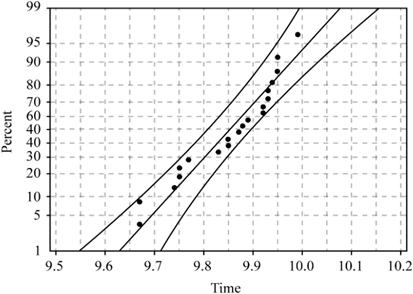
If the given data points on the plot cluster close to the straight line, then, the sample distribution attains normality.
From the plot, it is clear that distribution follows approximately normal distribution. Therefore, t-test can be used.
Step 3
The calculation for the given data in tabular form;
| SL. No | x | \[{\left( {{x_i} - \,\bar x} \right)^2}\] |
| 1 | 9.85 | 6.25E-06 |
| 2 | 9.94 | 0.007656 |
| 3 | 9.88 | 0.000756 |
| 4 | 9.93 | 0.006006 |
| 5 | 9.85 | 6.25E-06 |
| 6 | 9.95 | 0.009506 |
| 7 | 9.75 | 0.010506 |
| 8 | 9.75 | 0.010506 |
| 9 | 9.95 | 0.009506 |
| 10 | 9.77 | 0.006806 |
| 11 | 9.83 | 0.000506 |
| 12 | 9.93 | 0.006006 |
| 13 | 9.67 | 0.033306 |
| 14 | 9.92 | 0.004556 |
| 15 | 9.92 | 0.004556 |
| 16 | 9.87 | 0.000306 |
| 17 | 9.74 | 0.012656 |
| 18 | 9.89 | 0.001406 |
| 19 | 9.67 | 0.033306 |
| 20 | 9.99 | 0.018906 |
| Total | 197.05 | 0.176775 |
Mean of flame time is;
\[\begin{array}{c} \bar x\, = \,\frac{{197.5}}{{20}}\\ = \,9.8525 \end{array}\]Standard deviation of flame time is;
\[\begin{array}{c} s\, = \,\sqrt {\frac{{\sum {{{\left( {{x_i} - \,\bar x} \right)}^2}} }}{{n - 1}}} \\ = \sqrt {\frac{{0.176775}}{{19}}} \\ = \,0.096457 \end{array}\]On substitution, t-statistic becomes;
\[\begin{array}{c} t\, = \,\frac{{\left( {9.8525\, - \,9.75} \right)}}{{\frac{{0.096457}}{{\sqrt {20} }}}}\\ = \,\frac{{0.1025}}{{\frac{{0.02157}}{{\sqrt {20} }}}}\\ = \,4.7523 \end{array}\]The test statistic is 4.7523.
Use the t-distribution table, at the 0.05 level of significance, the critical value for 19 degrees of freedom is 1.7291 which is less than the test statistic value. Hence, null hypothesis can be rejected.
Thus, there is solid evidence that the true average flame time for strips of the treated children’s nightwear more than 9.75 at 05% level of significance.